Blog

  • Mere leg i skolen!

    Mere leg i skolen!

    Som så mange andre er jeg bekymret over den udvikling, der præger både vores samfund og vores uddannelser disse år. Optagetheden af kontrol og forudsigelige, målbare resultater i alle aspekter af livet er problematisk af mange grunde, og ikke mindst fordi den marginaliserer legen. Det udgør en væsentlig trussel mod vores livskvalitet, og paradoksalt nok også mod de resultater vi er så opsat på at måle, herunder ønsket om at forandre verden til det bedre. Denne udvikling er med al tydelighed slået igennem i hele vores uddannelsessystem, hvor vi i en misforstået jagt på “læringsmaksimering” er i fuld gang med at underminere grundlaget for, at børn og unge bliver rustet til at navigere, agere og leve et godt liv i en kompleks og kaotisk verden.

    “But it’s wrong to think of playing as the interruption of ordinary life. Consider instead playing as the underlying, always-there continuum of experience” – Richard Schechner

    For mig er leg ikke blot “for sjov”, “for børn” eller “spild af tid”. Leg er ikke blot en aktivitet, men også en særlig sindstilstand og måde at møde verden på. Det “legende” definerer, udvider og omkonfigurerer en persons repertoire af handlemuligheder. Legen er udtryk for en deltagelseskultur, hvor de legende indgår i en løbende forhandling om formål, mål og regler. Hvorfor leger vi? Hvordan skal legen foregå? Hvem indtager hvilke roller? Dermed er legen afhængig af, at de legende forstår hinanden og sammen kan få legen til at fungere. I den henseende giver legen os mulighed for at afprøve nye roller og nye måder at være sammen, og dermed også hvordan vi kan finde sammen, altså hvordan samfundet kan indrettes. Hermed føjes en etisk dimension til legen, hvor vi undersøger hvad vi opfatter som “rigtige” og “forkerte”, “gode” og “dårlige” måder at indgå i små og store fællesskaber. Det forudsætter en veludviklet empatisk sans, som kan styrkes yderligere gennem leg med andre.

    How do we discover who we are? How do we determine the character of the world in which we live? And how do we decide what we can do in a world so configured? […] we learn about ourselves and the world— and about the intersection of these two realms— through acts of play. – Thomas S. Henricks

    Legen er altså vævet tæt sammen med den dannelsesopgave, der stadig står centralt i folkeskolens formålsparagraf, og jeg er sågar overbevist om, at mennesker der lærer (og tør) at være legende, også er mennesker, der er bedre klædt på til livet.

    Når vi har indrettet et system, der frygter og søger at udgrænse legen, så er det selvfølgelig fordi leg i sin natur er svær at kontrollere og forudsige. Det er jo legens styrke, og det vi i virkeligheden har brug for er netop det uforudsigelige, det kreative og det nytænkende, der ikke kan tæmmes. Leg er ikke noget, vi skal hive ind i skolen som et simpelt instrument til træning af dette eller hint eller som en gulerod afkoblet fra fagligheden. Hvis legen skal have en meningsfuld rolle i skolen (og det mener jeg jo så absolut den skal), så skal det ske på legens præmisser (se også dette blogindlæg). Derfor har vi behov for rum til at tale om legen, udforske den og eksperimentere med den.

    Nu hvor der desværre er så meget mere fokus på læringsmål end leg, så besluttede jeg for nogle år siden at starte et lidt andet sted. Parallelt med mit arbejde med uddannelse arrangerer vi derfor, for tredje gang, CounterPlay festivalen, som afholdes 14.-16. april på Dokk1 i Aarhus. Formålet med festivalen er netop at skabe et rum, hvor vi, på tværs af fag- organisations- og landegrænser kan udforske legens mange muligheder. Med festivalen siger vi højt, tydeligt og forhåbentligt helt umisforståeligt, at legen er vigtig for os alle, både når vi lærer, arbejder og lever. Vi fokuserer både på, hvordan legen og det legende mindset kan øge glæde og livskvalitet, og hvordan vi kan blive mere empatiske, nysgerrige, kreative og innovative.

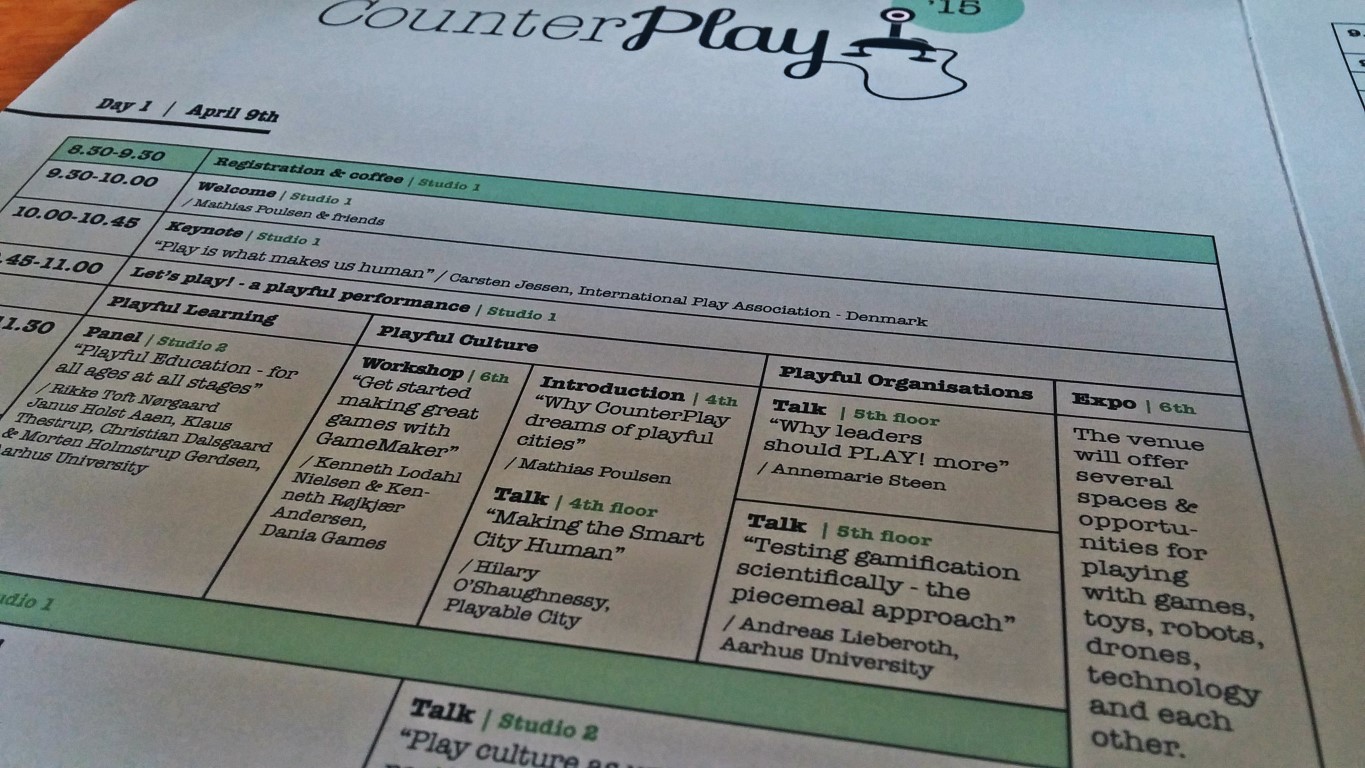
    Festivalen rummer, ud over hele dannelsesperspektivet, flere konkrete temaer og aktiviteter, som peger direkte ind i skolens univers. Det gælder selvfølgelig “Making Education Playful”, men også “Reconfiguring the Playful Maker”, og “Developing a Language of Play”, for hvordan argumenterer vi for legens legitime plads i skolen uden et kvalificeret fælles sprog? Første udgave af programmet er netop offentliggjort, og jeg er ret overvældet over hvor mange spændende mennesker fra hele verden, der har lyst til at være med.

    Jeg er samtidig smerteligt bevidst om, at festivalen ikke kan ændre alverden, det siger sig selv, men jeg mener, at vi må starte et sted. Vi må opdyrke fællesskaber og skabe en bevægelse. Det er selvfølgelig ikke muligt at ændre alting fra den ene dag til den anden. Tværtimod må vi væbne os med tålmodighed, og tage små skridt i retning af den verden, vi drømmer om. Vi kan skabe rum til leg og eksperimenter inden for de nuværende rammer og strukturer, og på den måde kan vi, på længere sigt, skubbe til selvsamme rammer

    De første to år har mange lærere og pædagoger deltaget, og forhåbentlig kan vi fortsætte den udvikling. Der er intet jeg hellere vil end bidrage til en mere legende kultur på vores uddannelser. Det er på høje tid.
  • The Play Paradigm

    The Play Paradigm

    Discussions about play are too often blindsided by a lack of common language, a very narrow understanding of play, and a belief that play is only relevant if assimilated into the current paradigm as simple instruments with measurable and predictable outcomes.

    Because of this, many people don’t consider play to be “for them”, and many conversations are riddled with stereotypes and misunderstandings.

    I think we need something else. We need a different way of framing play.

    What we really need is a big, bold, far-reaching vision for play, an unmistakable argument, and an understanding that can never be reduced to popular categories like children’s play, playgrounds, toys or games. We need a vision that encompasses all of us, spans entire societies and engages in the most foundational negotiation of meaning and purpose. Looking at play like this, it becomes a moral compass, a philosophy, a way of life and even a new PLAY PARADIGM to challenge and transform the current shape and course of the world.

    This is the essence of CounterPlay: we transform ourselves and society by being playful.

    What does this mean? How is play transformative?

    IN PLAY, we are seeking the sheer joy and pleasure inherent to a playful mood, and we increase our quality of life by playing. In a playful state of mind, we are allowed and able to smile and laugh, even in the face of adversity.

    IN PLAY, we are open to the infinite complexity of the world and the diverse experiences it brings. We are actively participating, exploring other ways of being, as we transform ourselves and the world in a constant movement back and forth, where we are not seeking equilibrium or perfection, but rather the possibility space of the imperfect.

    IN PLAY, we negotiate meaning and purpose through social interaction and play becomes an exercise in empathy and in designing a meaningful way to be together.

    IN PLAY, we ask questions, our imagination awakens, we can escape the confines of cognitive patterns and engage in an act of creative expression.

    IN PLAY, we embrace unpredictability and the unknown becomes a catalyst for curiosity. We are resilient, not deterred by failure, but inspired by it, and we we are not afraid of danger or risk, but attracted to examining the mechanics of fear.

    IN PLAY, nothing is necessary, but anything is possible when we reconfigure power structures and challenge conventions. By asking questions, moving to the edge, pushing boundaries, play is rebellious.

    These are some of the traits that makes play so important in every aspect of our lives, but this is only where the conversation begins…so what am I missing?

  • What is playful leadership?

    What is playful leadership?

    “if we want to make it safely and sanely through all the changes coming our way, we’re going to need to come out and play” – Bernie DeKoven

    Play is, perhaps more than anything, a fundamental source of fun, joy and well-being throughout our lives. It’s not reserved for children, and it’s not a luxury or something we do, when every other need is satisfied. On the contrary, it’s an “underlying, always there, continuum of experience” (Richard Schechner).

    Playful leadership then becomes a matter of cultivating playful mindsets and playful culture. As such, a playful leader is a leader, who not only accepts, but actively supports a playful culture.

    Why would you do that?

    Play opens up an organisation to the world, and it can’t be controlled. In play, we embrace the unpredictable. “When we adopt a playful attitude, we’re more open to a diverse, even divergent, set of possibilities” (Herminia Ibarra). We accept that the world is complex and chaotic, and we increase our ability to navigate this complexity. Quite often, play does not have a clear and pre-determined outcome, and if there is a goal, we usually don’t know how to get there. The playful leader may be the one proposing a vision and a direction for the organization, but it can never be set in stone. As an integral part of play, we engage in a constant movement, and an ongoing negotiation of rules, goals and meaning. Play challenges existing hierarchies and power structures, as everybody playing is part of this negotiation.

    When you’re a playful leader, you are able to instill a the people around you with the courage to experiment, and to take steps into the unknown, to break free from patterns and habits. In play, anything is possible. The entire world could be different. Your imagination is set free, your creativity runs wild, and your most crazy ideas may be the most meaningful ones. You take risks, and sometimes you end up in unexpected and perhaps even controversial territory. This creates a “friction” between us and the world, which generates questions. It’s a particular sort of “Verfremdungseffekt”, where we see the world “through the lens of play, to make it shake and laugh and crack because we play with it” (Miguel Sicart).

    In this process, we connect with each other in new ways, be it friends, colleagues or strangers. Play is an act of expression and communication. We can play with our relationships, roles and our identities, and we can develop our empathy by adopting new perspectives on the word, just as “playfulness may serve as a lubricant in productive work-relations” (Proyer & Ruch).

    …and these are just some of reasons, why I think we should do much more to explore and adopt more playful approaches to leadership.

    Would you care to share your thoughts in the comments?

  • Organising CounterPlay ’16

    Organising CounterPlay ’16

    Working on CounterPlay ’16, it’s clear that we need to also focus on the way the festival is organised. Even though we want CounterPlay to be deliberately (somewhat) chaotic to support a more relaxed, informal and playful atmosphere, we also strive to make it as meaningful as possible.

    It’s a constant dance between rigid structure and full-blown chaos. Some people want more of the former, while other wish for more of the latter. People are different, and there’s no way to make everybody happy, but we’ll try to keep learning from our experiences. It needs to feel right, and that calls for some consideration and changes on multiple levels. I think the festival should retain some of the conferency elements, while also moving more towards a proper festival. So far, CounterPlay has mostly been for those who pay to participate in the whole shebang, and while that is a good foundation, we also need more open access to parts of the festival. Maybe the festival could be an entire week of playful events and then the confestival (that is supposed to be more festival than conference) would be Thursday-Saturday?

    Organisation

    How do you structure something like this? counterplay_schedule (Medium) For the first two festivals, we’ve used three parallel tracks representing (roughly) culture & society, education and organisations. It also served the purpose of signalling the different approaches to playfulness. It was a way to say:

    Hey, this is not just for teachers / librarians / consultants / leaders / journalists / politicians / game developers / commuicators / and-so-on

    Rather, it’s for all of these people and many, many more. We wish to cultivate communities of different people, professionals, who can benefit from playfulness in their everyday life and work. This remains at the core, but I think, however, that we may need to create a more flexible and transparent framework and maybe it’s time to leave the three rigid tracks behind. Maybe we should instead use a combination of a more elaborate tagging system with informative keywords and an indication of the complexity of each session. If a session is based on,say, specific experience with designing for urban spaces, and it requires a bit of knowledge beforehand, it could be tagged: [su_label type=”success”]Creative Development[/su_label] [su_label type=”success”]Design[/su_label] [su_label type=”success”]Urban Spaces[/su_label] [su_label type=”warning”]Complexity: Medium[/su_label]   We would still have to schedule things, so too similar sessions are not right on top of each other, but I think we could make things a lot more flexible and transparent with the right tagging system.

    Formats

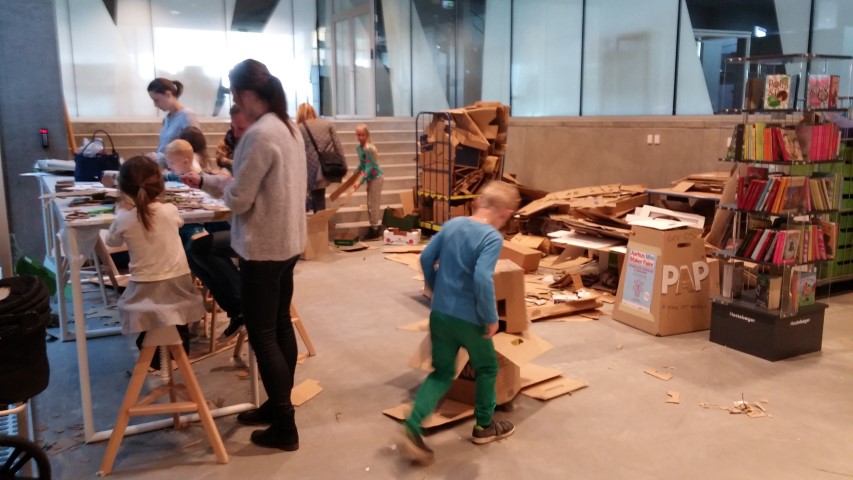
    We’ve been experimenting with many different formats, and we’ll undoubtedly continue to do so. What we really want, is to increase the level of interactivity: less one-way talk, more debate, action and play. We suggest that every contribution is playful by nature, but we should probably take it further and have less traditional talks. Maybe we could reduce the “talks” to a handful of keynotes and some super short talks (e.g. Pecha Kucha or Ignite) and focus more on the activity-based content? Maybe something like this, where the main formats are PLAY/CREATE/DEBATE? [su_tabs vertical=”yes”][su_tab title=”Play”]CounterPlay is about many things, but play is obviously central. It’s important for us to create spaces for many kinds of play, letting diverse groups of people play in many different ways with many different purposes. Next year, we’ll have the best conditions for this with the big open spaces of DOKK1 and we strive to put play at the heart of everything. TurtleWushu_1 (Large) [/su_tab] [su_tab title=”Create”]The festival should be a space for creating, ranging from making games, toys and new ways to play to creating new ideas and ways of thinking about play. We should have spaces for building things out of cardboard and wood as well as bits and pixels, and generally remember that to create can mean many different things. 2015-10-11 14.43.09 (Small) [/su_tab] [su_tab title=”Debate”]We love insightful debates and conversations, and the idea about bringing different people together to explore playfulness together calls for lots of opportunities and spaces where these exchanges can happen. It can be panels, roundtables, informal conversations, open spaces and much more. The important thing is that it’s not just one person talking. 20150410_115537 (Small) [/su_tab] [su_tab title=”Keynotes”]While the interactive elements should be central, sometimes the best thing is to listen to inspiring people share their passion and unfold their arguments in a bit more depth, and I imagine this can take place in a handful of keynotes during the festival. 20150410_090646 (Small) [/su_tab] [su_tab title=”PechaKucha”]These super short and condensed talks can be extremely energetic and inspiring, and would be a perfect way to share ideas and experiences for further work and discussion. [/su_tab][/su_tabs]

    Themes


    The festival always aims to explore playfulness from many angles and in many different areas of society. We won’t try to force everything into boxes and categories, but we will be selecting specific themes to investigate in a bit more depth. For next year, we are currently exploring a few themes in more detail:

    [su_tabs vertical=”yes”][su_tab title=”Leadership”]We read an article and had a discussion in our Facebook group on “playful leadership”, and it seems like a very important topic to investigate. If we want to create real changes anywhere, leaders play a central role and need to participate in the ongoing conversation and exploration.[/su_tab]

    [su_tab title=”Urban Spaces”]We’re very interested in creating more playful cities, and enabling playful interventions in urban spaces. When people start playing in our cities, it creates a kind of friction that helps us question the very purpose of the city.[/su_tab]

    [su_tab title=”Playful Society”]This is a probably too broad and in a way it’s more a part of our long-term goal to create a more playful society. Even so, we’ve had some really interesting conversations with people on what constitutes a playful society, how we move in that direction and how we know when we’ve got it – and more. Follow #playfulsociety on Twitter to keep up.[/su_tab]

    [su_tab title=”Cardboard”]We hosted the Global Cardboard Challenge, and we love all the creative constructions people are making when playing with cardboard, so we’ll definitely include this as a theme in the festival.[/su_tab][/su_tabs]

    Aside from these, we are still open to suggestions.

    I would personally like to also explore areas like “playful activism” and “playful global citizenship”, but let’s hear what you think.


  • Playful Libraries – writeup from Next

    Playful Libraries – writeup from Next

    We’ve been fortunate enough to be a partner at the international Next Library 2015 conference, which has just taken place in the fantastic DOKK1 building here in Aarhus (where CounterPlay ’16 coincidentally also happens to play out next year).

    I was there on behalf of CounterPlay, and contributed with a super short “ignite talk” and a longer “Play & Create“. Both were framed around the same basic assumption:

    I think playful people might be better equipped to live in this world

    While the ignite talk was pretty terrifying in its hectic intensity, the “Play & Create” session was absolutely hilarious. Both were utterly amazing experiences. The same goes for the Next conference in general. I’m extremely impressed by the Next conference crew, the use of the venue and – not least – the incredibly passionate, sincere and inspiring participants and contributors (do take a look at the #nextlibrary2015 hashtag, which is full of important ideas & thoughts on the future of libraries).

    A World of Playfulness

    20 slides, 15 seconds each. Seriously. Who thought the Pecha Kucha format was too lenient and decided to shave off 5 seconds per slide?

    Anyway, it was a great exercise in getting to the point and keeping everything sharp (I’m not saying I succeeded, but I enjoyed trying).

    Why not engage one of the biggest and most confusing questions I’ve currently wrestling with?

    https://twitter.com/janholmquist/status/642996859481522176/photo/1

    I tried to show some of the possible links between “global citizenship” and playfulness using a couple of my favorite quotes:

    it’s wrong to think of playing as the interruption of ordinary life. Consider instead playing as the underlying, always there, continuum of experience” (Richard Schechner)

    To play fully & imaginatively is to step sideways into another reality, between the cracks of ordinary life” (Thomas S. Henricks)

    Playfulness means taking over a world to see it through the lens of play, to make it shake and laugh and crack because we play with it” (Miguel Sicart)

    In the end, I asked two questions.

    One regarding the work being done at libraries all over the world (by people like the participants at Next):

    Could you embrace playfulness as a strategy in the transformation of libraries?

    The second question was directed at all the people using libraries:

    Could you create libraries that to an even greater extent help people become more playful?

    Here’s my presentation:

    Play & Create

    This session was longer (90 minutes) and took place in the open space at the ramp in the middle of DOKK1.

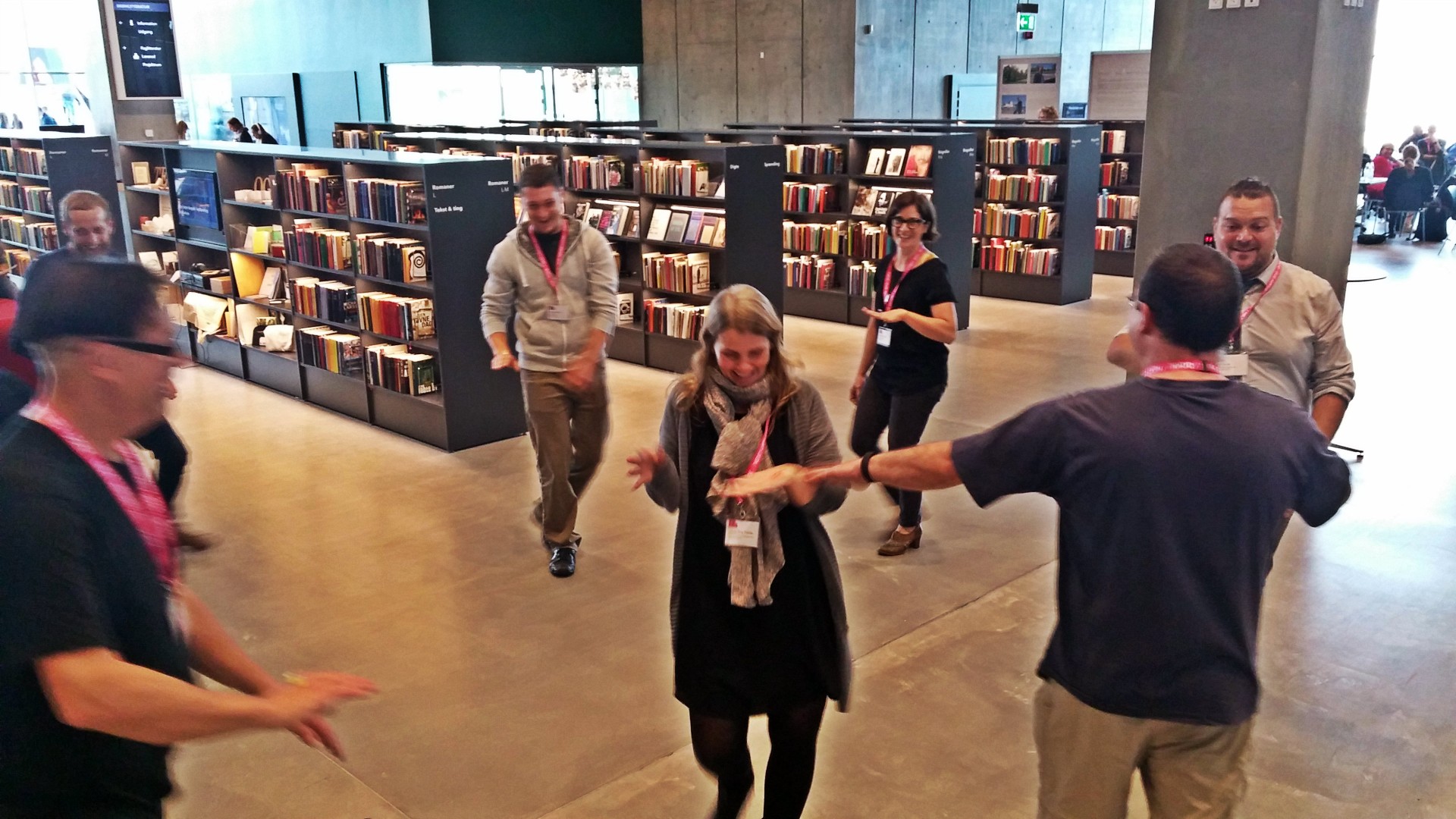
    After my brief introduction, we played a couple of rounds of the wonderful “Turtle Wushu” developed by Invisible Playground (I wasn’t able to find turtles, alive or plastic, so maybe what we played was in fact “Dice Wushu”).

    TurtleWushu_3 (Medium)

    We only played for 10-15 minutes, but it really had an impact on the energy of the remainder of the session.

    I then talked for a bit, trying to provide som background for the game we just played and the upcoming play jam. My basic argument for playing and being silly is something like this:

    It’s not so much about the games or play activities as such, but rather about learning to be playful.

    Together, we came up with three words or dogmas and each group would choose one of these as a starting point for developing a “new form of play” in 30 minutes:

    When the groups started jamming, an already nice atmosphere turned into something almost magical. They were so engaged in the task at hand and clearly didn’t hold themselves back.

    In the end, we had three concepts that could readily be played by others, each based on one of the three dogmas.

    Sensing/senses

    In the beginning, this was played with a blindfold or eyes closed. You had to sense where the other players were and then smash their balloon.

    In the final version, you were allowed to see, and you could defend yourself with bubbles that the other players couldn’t move through.

    Discovery

    The idea behind this was the fact that we rarely go exploring the spaces we often visit.

    You begin by spinning a bottle. Then you go in that direction, and introduce yourself to the first stranger you meet and challenge that person to a “bubble race”. You blow a bubble each, and try to move that bubble as far as you can.

    Excitement

    Here, you had to stand in a designated spot and play out one of three roles: blow bubbles, catch bubbles or use a piece of paper to prevent the catching of bubbles.

    There is a rotation system, so you move between the three roles. That can be done after a set number of bubbles is caught or a set amount of time. You can add more players for increased difficulty (and confusion and laughs).

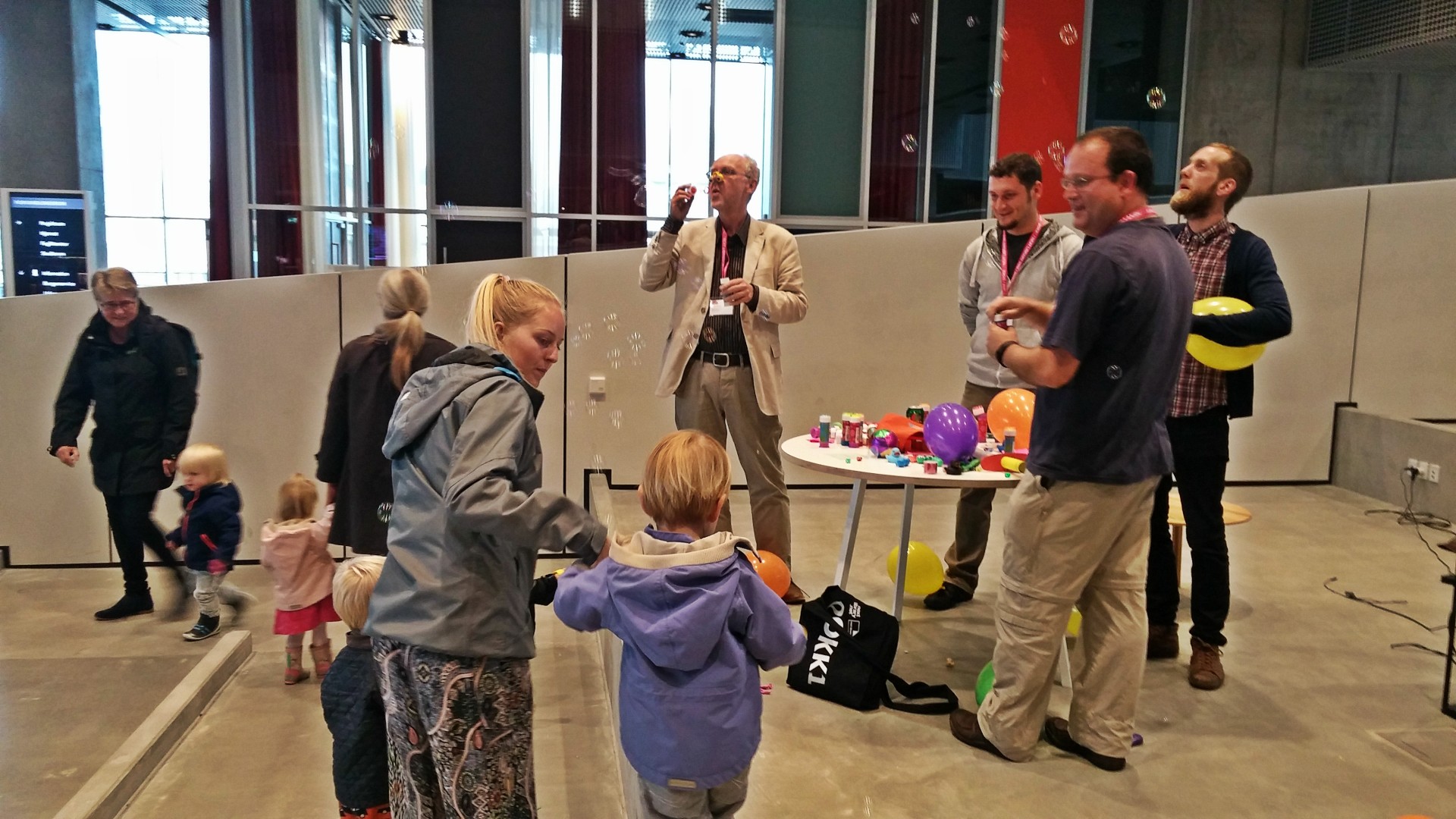
    All three forms of play were hilarious and certainly made a lot of people (Next participants as well as regular library visitors) smile and laugh.

    The fact that the workshop took place out in the open created a disturbance and “friction” for the regular guests at the library, which was extremely interesting to watch:

    This was one of the best experiences I’ve had doing a workshop for a long time and only because of the wonderful, sincere and hugely energetic effort of the participants!

    One of the participants said to me, with a big smile, that he hadn’t done something like this since he was a child – with the underlying question: WHY haven’t I done something like this since I was a child? (well, that was my interpretation, at least).

    That really meant a lot to me.

    Other people came up afterwards and thanked me, which made me a little proud and super grateful, but it also just made me want to thank the participants. They did most of the work and they made sure the session was that much fun.

    I need to do something like this again soon. It seems to be even more valuable than I would have expected.

    Here’s my presentation:

  • The Play Deficit

    CounterPlay has always been interested in playfulness all over society and the world; everywhere.

    We want to go beyond games, beyond play as an activity, also exploring the meaning of being playful. We want to cultivate playfulness where there is none, and we want to explore what happens when we do.

    Now we’re working on becoming more than “just” the annual festival, and as part of that process, we want to identify some of the least playful parts of society:

    Peter Gray argues quite convincingly that school is one of the areas with a huge play deficit and with enormous consequences:

    To the degree that we take away play, we deprive children of the ability to practise adulthood, and we create people who will go through life with a sense of dependence and victimisation, a sense that there is some authority out there who is supposed to tell them what to do and solve their problems. That is not a healthy way to live.

    Which areas of society do you think would benefit the most from having a larger concentration of playful people? What happens if don’t allow or support play more consistently? How can we do it?

    Let us hear from you in the comments below or in the CounterPlay group on Facebook!


  • Impressions from CounterPlay ’15

    Impressions from CounterPlay ’15

    With the second edition of CounterPlay over, we’re working on evaluation and documentation…and slowly preparing for CounterPlay ’16.

    I thought I would share some thoughts from behind the (already fairly transparent) scenes, so this post is my personal reflections on my work with and experiences from the festival.

    Leading up to the festival, I had been equal parts busy and terrified. So many things could go wrong, so many people could end up being disappointed. I had expected things to be easier than the first time, but it was the exact opposite. Almost every single thing was harder. Maybe the newsworthiness made the first time more smooth, maybe more was at stake this time. Part of it certainly had to do with moving to a new venue.

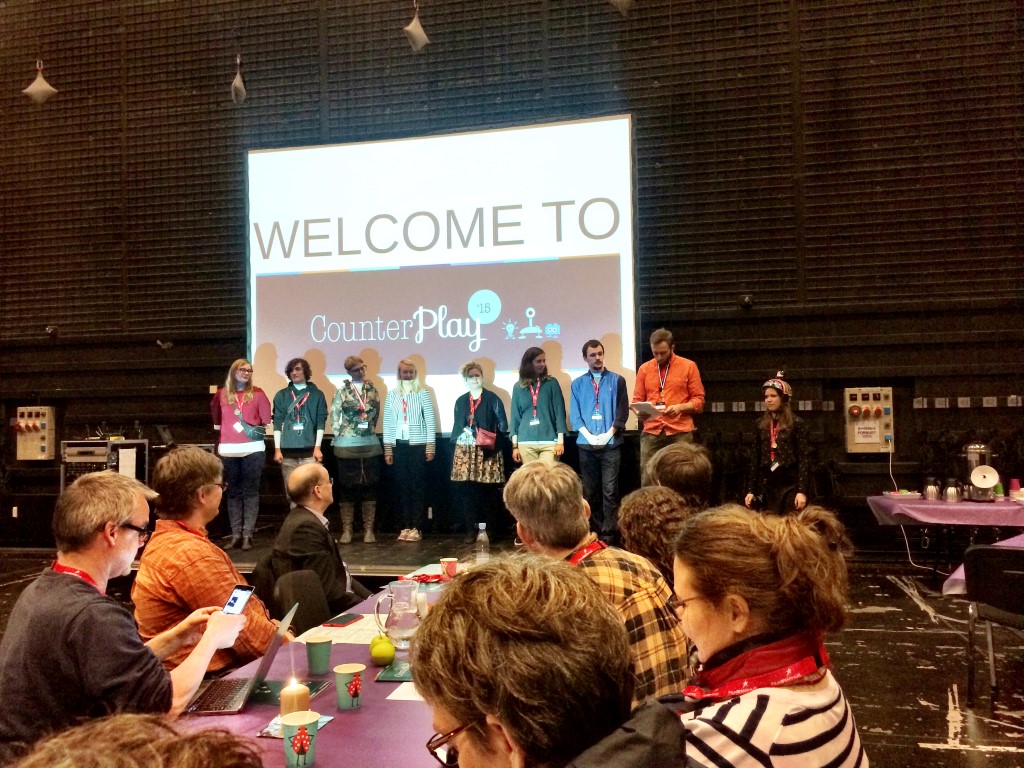
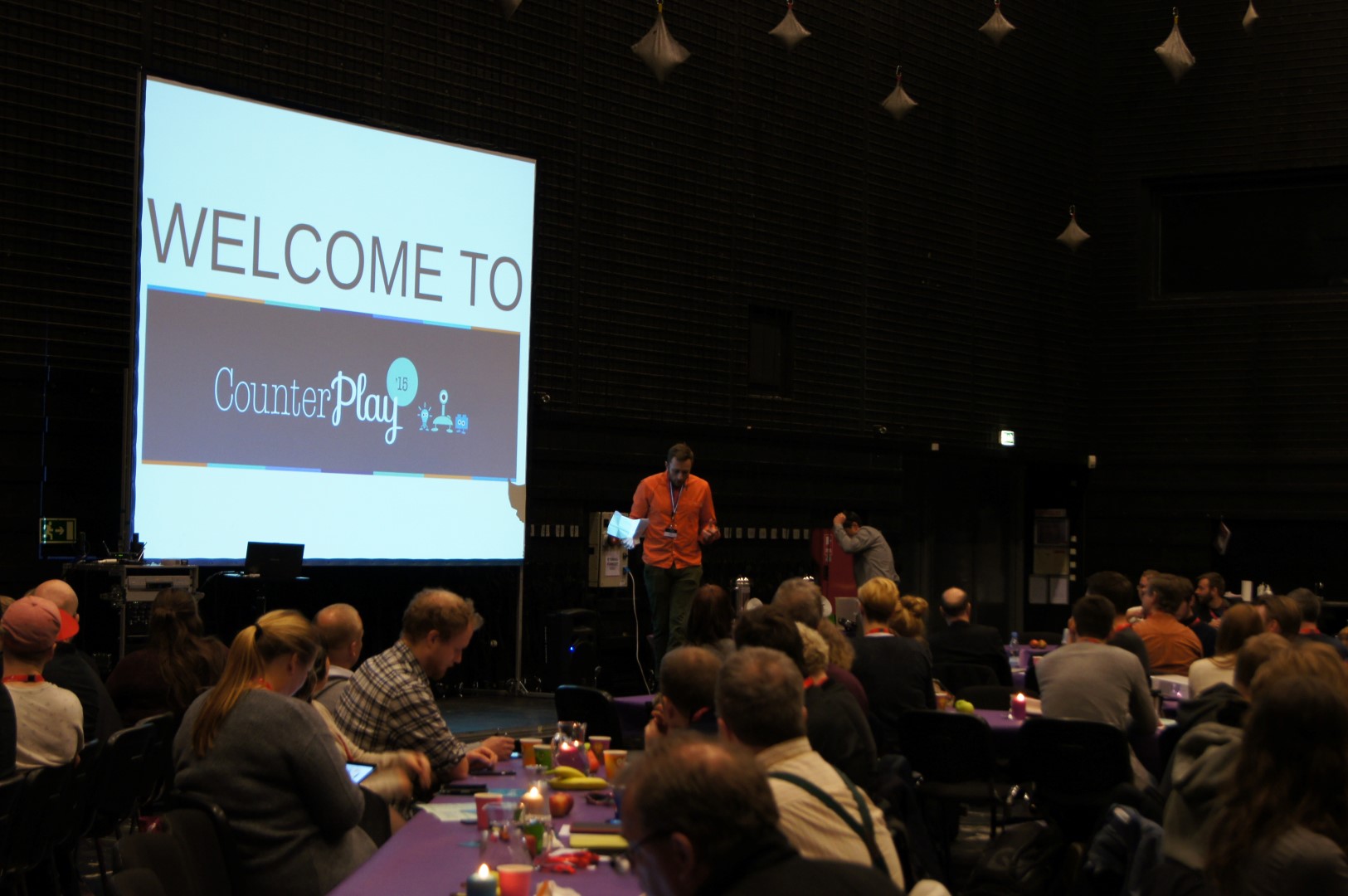
    When it was finally time to welcome all the wonderful participants, well, I was still terribly nervous. Almost 200 lovely people were seated, ready to dedicate two days of their busy lives to engage with a topic so incredibly important to me.

    SONY DSC

    I said some things:

    We want to connect domains, that are usually disconnected. We want to bring people together, who would probably not otherwise meet. These days, it’s easier than ever to stay in our own circles or “bubbles”, as it’s often called. I really, truly believe that for better things to happen in this weird, messy world, we need to explore things that matter – together. We need to accept that no single homogenous group can do much by themselves.

    Play can be utterly transformative, it can change the way we interact with each other and the way we see the world around us. When we’re playing, we’re in another state of mind. Play allows us to see things in a different light, it can create a kind of “friction” between us and the world.

    I always wanted you to use the festival to create something, that is important to you. I can’t stress this enough – please steal the festival! Please use it as a framework, a lens, a stage. If you feel like making something happen during the festival, just go ahead.

    And then it all began.

    My gut feeling says I should be satisfied. I’m calm again, and I’m happy with how it went. People smiled a lot and many lovely participants said very nice things.

    What I loved

    More than anything, I’m impressed with the atmosphere (again). Early on, I got the impression that people felt safe, relaxed, eager to participate and play. It’s the most important part of CounterPlay and what must be preserved at all costs. It’s illustrated beautifully by this that happened at the end of Elaine Rumboll’s wonderful keynote:

    https://vine.co/v/eB2b5KB2Tld

    While we had several hiccups, things that didn’t go according to plan and small surprises, I think most sessions went more or less like they were supposed to. This was only partly due to our planning, and mostly due to the amazing flexibility of the many wonderful contributors and incredibly helpful participants – so thank you, all of you!

    CounterPlay is made up of so many different components, and this year it was also spread over a fairly big area, but it seemed like people were moving around a lot, exploring the different areas and tracks.

    After the main part of the festival, we hosted a smaller “academic workshop”, and while we were only around 15 people, it was a great opportunity to dwell on the impressions from the festival (thank you, Stine & Camilla for the effort you put into that!).

    People really embraced Twitter during the festival, and lots of discussions took place at #CounterPlay15 (all collected here). Let’s keep up that conversation (and do remember the Facebook group as well).

    Oh, and the food. Man, was I impressed by those people (Mefisto & Gourmiddag, if you’re curious). If we can, we’ll make sure to use them again next year, I promise.

    Things to work on

    While I’m generally happy, I also see lots of things to tweak and change (and I’m more than happy to hear from you in this regard).

    The “academic workshop” was a wonderful experience, partly because it was separated from the main part of the festival, but it also meant most people missed out. It was basically just a space to reflect upon and discuss some of the central topics at a slower pace. I think we’ll keep the workshop as a stand-alone activity, but we’ll also to figure out how to embed that “space” into the festival, maybe like a “World Café“, as suggested by Moire O’Reilly:

    The Play Space didn’t work out exactly as I had hoped. It wasn’t the central hub like last year; it wasn’t the rug that tied the room together. This can, to some extent, be explained by the venue combined with a tight schedule. Having to go all the way to the 6th floor, while things were going on elsewhere probably caused many people to miss it altogether. We’ll also need to work with the diversity of the content, so it covers a broader spectrum of playful activities.

    I know some people ended up at talks/workshops that weren’t what they expected. We can probably never avoid this, but we’ll have to make the program more transparent next year. We can improve the descriptions, maybe develop a model to ensure all descriptions answer some basic questions.

    Finally, I always intended to do more with CounterPlay than “just” the festival, and we’re currently contemplating how to do that. How do we take topics, issues, questions and debates from the festival and investigate them elsewhere – in schools, libraries, museums, private companies and so on. Can we facilitate playful experiments that link the festival to everyday practice? Initiatives that would themselves create value locally, but could also help develop the festival.

    Stay tuned, stay in touch, help us shape the festival and let’s stay playful together.

  • CounterPlay – på dansk

    Nu nærmer vi os hastigt den 2. udgave af CounterPlay, og vi arbejder på højtryk for at lave den bedst mulige festival.

    Personligt er jeg ikke et øjeblik i tvivl om, at det bliver en helt fantastisk oplevelse for alle involverede.

    Med festivalen forsøger vi at ramme en balance mellem det internationale udsyn, og den lokale forankring. Det er ret vigtigt for mig, at CounterPlay fastholder et internationalt sigte og opdyrker et internationalt fællesskab. Vi skal lave noget, der er godt og ambitiøst nok til at være relevant uden for landets grænser, og vi skal bringe perspektiver fra hele verden ind, så vi kan kvalificere det der foregår her.

    Det er imidlertid lige så vigtigt, at festivalen er stærkt forankret i Danmark, både lokalt, regionalt og nationalt.

    Den problemstilling modtager vi gerne hjælp til at håndtere, både nu og på længere sigt.

    For at forklare nogle af tankerne bag, og gøre det (forhåbentlig) lidt mere klart, hvem der kan have gavn af at deltage, har jeg lavet disse fire videoer, der hhv. berører festivalen overordnet set, og de tre hovedområder, Playful Culture, Playful Learning og Playful Organisations:

  • CounterPlay ’15 Contributors #1

    We’ve been working hard on CounterPlay ’15 for the past several months, and we’re very happy to announce the first batch of contributors for the upcoming festival. While this is already an amazing collection, we’ve got a lot more coming, and we aim to have a first edition of the actual program ready within a few weeks.

    The contributions cover several different formats and activities, from talks to workshops and playful events, as well as a lot of things in between. The common denominator is the playful approach – to education, to culture, to our jobs, to communication, to our lives (we are working on some guidelines for CounterPlay contributions, where we ask one central question: how do you playfully engage your participants?).

    Let’s get to it:

    From the outset, I realised that “Playful Organisations” (“Playful Business” at the first festival, and here’s a flyer we’re working on) would probably be the hardest one to communicate. A lot is going on in the pretty wide domain of “Playful Culture”, and I’ve also seen a huge boost in “Playful Education” lately, but it seems it takes a bit more work to link this to the work going on in companies and organisations. That’s why we’re putting an extra effort into this domain, and we’ve got a skilled local, Morten Fryland from “Playground Marketing“, helping us out:

    In the same category, I’m really happy that Elaine Rumboll from South Africa is coming, and that she’s already put such a big effort into helping us (Elaine wins additional points for getting in touch not despite but because of the informal (/chaotic) way we do things!):

    I am interested in helping leaders and teams achieve their next-level of thinking, using the power of play.

    From Hubbub, we’ve got Alper Çugun coming up. Hubub is “a playful design consultancy and a studio for playful products” and their tagline is “design for a playful world”. I feel they’re a good match 🙂

    Annemarie Steen is “serious about playfulness” and is going to tell us about her work with enabling serious organisations to play more:

    From Aarhus University, Andreas Lieberoth (who recently published the very interesting study on “Shallow Gamification“) will be sharing some of his work:

    We’ve got Scott Nicholson coming over from the US to talk about some of his amazing work with “participatory design and Game Jams as a form of play that create connections between organizations and their users” as well as “meaningful gamification, which, at the heart, builds on using Play instead of Points”. Scott is a veteran in deploying games and playful methods and approaches to new arenas, and has been paving the way for all kinds of organisations to embrace playfulness:

    As we’ve mentioned before, we’re working on a “Playful Cities” theme for CounterPlay ’15, and we’re humbled that some of the pioneers running the “Playable City Conference” in the UK will be coming to talk & host a workshop with us:

    Another incredibly interesting and unique perspective on the playful city is brought up from Verona by Tocatì: International Festival of Street Games:

    Carsten Jessen is one of the leading Danish researchers into the nature of play (including playing with media), and he’s the head of the Danish charter of the International Play Association, with whom we’re collaborating):

    Over in the UK, Let Toys Be Toys are doing an impressive job of challenging the widespread dichotomy between “toys for boys” and “toys for girls”, and we’re looking forward to learning more about that effort (and how we can help):

    At the moment, Odyssé is preparing a quite impressive experience, “InsideHamlet” to take place over a weekend at Elsinore Castle. At CounterPlay ’15, they’ll share their insights on creating engaging, participatory experiences:

    The local game collective “GOLD” will be contributing with some of their wacky contraptions and ideas, hosting an ongoing workshop making games and playful stuff:

    an Aarhus based game collective that wants create games that moves people

    In the same category of local developers, Pelle Sølvkjær Christensen, GameCraft, and Esben Kjær Ravn, Kong Orange, will share some of their work as well as help us set the stage for creating more playful experiences:

    Over the past several years, the team behind “Skolen i Spil” (“Scool@Play”) has been doing some incredibly impressive work with games, elements from games and playful approaches to education. They were at CounterPlay ’15, and we’re happy they want to come back with an even more playful contribution:

    Coming down from Norway, Jørund Høie Skaug, Kristine Sevik & Terje Pedersen are going to talk about their experiences with drones and robots in schools, and I’m sure they’re bringing some interesting stuff to play with as well:

    André Chercka is running the “Gameworkshop“, and he’s probably the single most experienced person in Denmark when it comes to facilitating playful learning experiences with various games (especially Minecraft). At CounterPlay ’15, he’ll be sharing some of his insigts, allowing you to try it out for yourself:

    Almost last & the contrary of least, there’s Rikke Toft Nørgaard & Janus Holst Aaen  at “Centre for Teaching Development and Digital Media“, Aarhus University, who are putting a very big effort into the “Playful Education” part of CounterPlay. In fact, they’re making an additional “call for contributions” and engaging a host of students to come up with playful projects & concepts. As if this wasn’t enough, they’re also running the local charter of the amazing & inherently playful tech playground for kids, “Coding Pirates“, so expect a wide array of opportunities to create, play and transgress!

    Oh, and I’m quite sure that members of our advisory board will also contribute (I know they’ve got much to share, so how could they not – no pressure).

    Yup, I think that’s that for now. We’re truly grateful that these amazing people want to play along – thank you!

    As already mentioned, we’ve got the first edition of our program coming out within a week or two, and many, many additional contributors – so stay tuned & stay in touch!

    The biggest thing you can do to help us?

    Spread the word, share it with anybody (also and especially those you wouldn’t consider playful).

    …because anybody could benefit from a little more playfulness.