Category: Art & Culture

  • Playful Philly

    Playful Philly

    [et_pb_section admin_label=”section”][et_pb_row admin_label=”row”][et_pb_column type=”4_4″][et_pb_text admin_label=”Text” background_layout=”light” text_orientation=”left” use_border_color=”off” border_color=”#ffffff” border_style=”solid”] [toc]

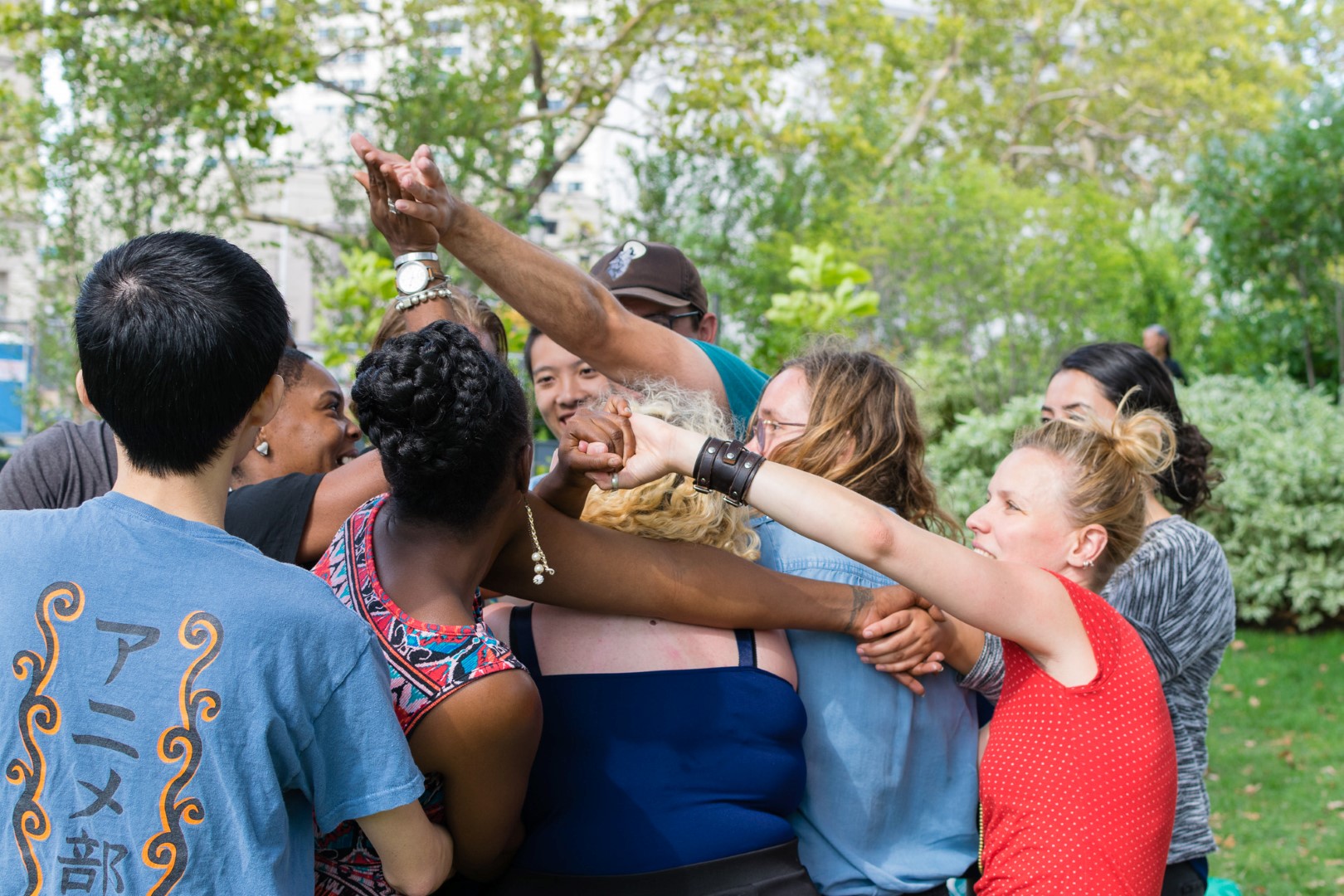
    A while back, I was invited to train a group of instructors, who would be leading six play camps across branches of the Free Library of Philadelphia. “Teach them about play”, my friend Joel requested, and of course I immediately said yes. The training week took place from August 7-10, and it was so much FUN! What a great group of people, who were incredibly eager to play and to create great spaces for kids to play.

    Playful Training Week
    I aimed for a playful training week, that would mirror the principles of play, we use for designing CounterPlay. The goal was that the instructors would develop:

    • A deeper understanding of the nature of play
    • A shared understanding of “play literacy”
    • An appreciation of the diversity of play and experience with different forms of play (nature play, dramatic play,
    • A basic skillset to design for play in practice

    The purpose of the camps were revolving around a notion of “play literacy”, to simply allow the kids to play and to improve their abilities to play well, alone and with each other. It was quite a privilege to be able to focus on “just playing”, as this is where the magic really happens.

    You can read more about the plan here, but we moved between many different formats and types of activities (short presentations, discussions, design challenges and play sessions) to understand play from many different perspectives. I really wanted to demonstrate the diversity of play, to encourage them be open to the ways the kids would want to play, and to make them feel confident in their own creativity and capacity to design and change games and play activities. We played a lot, everybody started sharing with the group, and the designed many, many brilliant activities, as I tried to provide them with some guidelines and things to consider:

    1. Always consider who will be playing in the space. How old are they? What is their background? How many will be playing at any one time?
    2. Try to accommodate for many different ways of playing. Create a range of invitations and make them open.
    3. Don’t make the space too safe. Allowing kids to play with risk is important!
    4. Include “loose parts”: things that can be moved, used and combined in many different ways.
    5. Be prepared to adjust the space when people start playing in it. Observe and listen to the players, they’ll be the experts in what works and what is fun. Trust the players!

    It was tremendous fun, the group were so friendly and passionate, and I think we got quite far in just four days, that flew by, really. We were playing most of the time, after all.

    I have collected a bunch of materials for the camp here.

    [/et_pb_text][et_pb_image admin_label=”Image” src=”http://www.counterplay.org/wp-content/uploads/2017/09/TrainingWeek-9-Large.jpg” show_in_lightbox=”off” url_new_window=”off” use_overlay=”off” animation=”left” sticky=”off” align=”left” force_fullwidth=”off” always_center_on_mobile=”on” use_border_color=”off” border_color=”#ffffff” border_style=”solid”] [/et_pb_image][et_pb_text admin_label=”PlayJam” background_layout=”light” text_orientation=”left” use_border_color=”off” border_color=”#ffffff” border_style=”solid”]

    Play Jam at Smith Memorial Playground and Playhouse

    While I was in Philly, I also got to host a small “play jam” at the wonderful Smith Memorial Playground and Playhouse. It was a beautiful summer afternoon/evening, and a nice crowd showed up, ready to play!
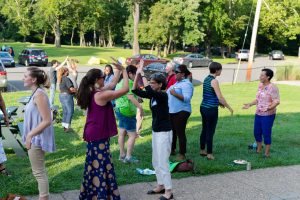
    We started by playing the not-that-famous “Danish Clapping Game“, before I asked everyone to think about and share their “favorite play memory” (what is yours?). I talked a little bit about why I find play to be so incredibly important for the good life, also and not least for adults (here’s my presentation).

    It’s always a delicate balance, where I feel it’s important to frame my way of thinking about play, but I’m also quite eager to get people playing before they fall asleep. It seems like we struck a decent balance here, and you really sense the energy: these people came to play!
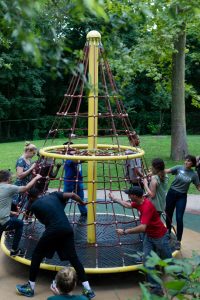
    I challenged the participants to design a new form of play with the theme “change” – in 30 minutes! I brought some balloons, soap bubbles and chalk, while the brilliant Smith people had a much larger collection of “loose parts“. People could use whatever they wanted as “props” for their play activity – including everything on the fantastic playground!
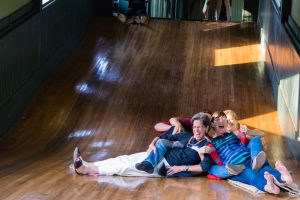
    Just as I had hoped, all the groups immediately embarked on an exploration of the loose parts and (not least!) the playground and the famous old wooden slide.

    It was amazing to see how they all just started playing, and then ideas and concepts started growing out of their shared enjoyment:

    “This is fun, but what if we do this?”

    “Yeah, and then we can use these balloons…”

    “Oh, yes, and if we all get on to this thing that goes round and round, then we have to pop the balloon…”

    “…with spaghetti?!”

    I was completely blown away and deeply impressed by their willingness to play, be silly, experiment, be open to each other and actually come up with some pretty hilarious concepts along the way! There was the “pop a balloon with spaghetti” game, the “ride the slide in a big bunch of people”, a haunted house, tag on a climbing…thing, a fantastic contraption, a soap bubble blowing game and a group, who were just looking for an excuse to hit each other with balloons.

    [/et_pb_text][et_pb_image admin_label=”Image” src=”http://www.counterplay.org/wp-content/uploads/2017/09/Temp_playjam-10-Large.jpg” show_in_lightbox=”off” url_new_window=”off” use_overlay=”off” animation=”left” sticky=”off” align=”left” force_fullwidth=”off” always_center_on_mobile=”on” use_border_color=”off” border_color=”#ffffff” border_style=”solid”] [/et_pb_image][et_pb_text admin_label=”Text” background_layout=”light” text_orientation=”left” use_border_color=”off” border_color=”#ffffff” border_style=”solid”]

    It was completely impossible to bring everyone back to present their ideas, since they just wanted to keep on playing.

    I *loved* it!

    The ideas were great, but the most important thing was the process, the exerimenting, designing and playing, the confidence that designing play activities are not really that hard and that everyone can do it.

    All in all, I enjoyed the trip to Philadelphia immensely, and am really grateful for the opportunity to meet and work with so many brilliant people; I can’t wait to find an excuse to go back!

    [/et_pb_text][et_pb_gallery admin_label=”Gallery” gallery_ids=”4855,4856,4857,4858,4859,4860,4861,4862,4863,4864″ fullwidth=”on” show_title_and_caption=”on” show_pagination=”on” background_layout=”light” auto=”off” hover_overlay_color=”rgba(255,255,255,0.9)” caption_all_caps=”off” use_border_color=”off” border_color=”#ffffff” border_style=”solid”] [/et_pb_gallery][/et_pb_column][/et_pb_row][/et_pb_section]
  • Playful Libraries – writeup from Next

    Playful Libraries – writeup from Next

    We’ve been fortunate enough to be a partner at the international Next Library 2015 conference, which has just taken place in the fantastic DOKK1 building here in Aarhus (where CounterPlay ’16 coincidentally also happens to play out next year).

    I was there on behalf of CounterPlay, and contributed with a super short “ignite talk” and a longer “Play & Create“. Both were framed around the same basic assumption:

    I think playful people might be better equipped to live in this world

    While the ignite talk was pretty terrifying in its hectic intensity, the “Play & Create” session was absolutely hilarious. Both were utterly amazing experiences. The same goes for the Next conference in general. I’m extremely impressed by the Next conference crew, the use of the venue and – not least – the incredibly passionate, sincere and inspiring participants and contributors (do take a look at the #nextlibrary2015 hashtag, which is full of important ideas & thoughts on the future of libraries).

    A World of Playfulness

    20 slides, 15 seconds each. Seriously. Who thought the Pecha Kucha format was too lenient and decided to shave off 5 seconds per slide?

    Anyway, it was a great exercise in getting to the point and keeping everything sharp (I’m not saying I succeeded, but I enjoyed trying).

    Why not engage one of the biggest and most confusing questions I’ve currently wrestling with?

    https://twitter.com/janholmquist/status/642996859481522176/photo/1

    I tried to show some of the possible links between “global citizenship” and playfulness using a couple of my favorite quotes:

    it’s wrong to think of playing as the interruption of ordinary life. Consider instead playing as the underlying, always there, continuum of experience” (Richard Schechner)

    To play fully & imaginatively is to step sideways into another reality, between the cracks of ordinary life” (Thomas S. Henricks)

    Playfulness means taking over a world to see it through the lens of play, to make it shake and laugh and crack because we play with it” (Miguel Sicart)

    In the end, I asked two questions.

    One regarding the work being done at libraries all over the world (by people like the participants at Next):

    Could you embrace playfulness as a strategy in the transformation of libraries?

    The second question was directed at all the people using libraries:

    Could you create libraries that to an even greater extent help people become more playful?

    Here’s my presentation:

    Play & Create

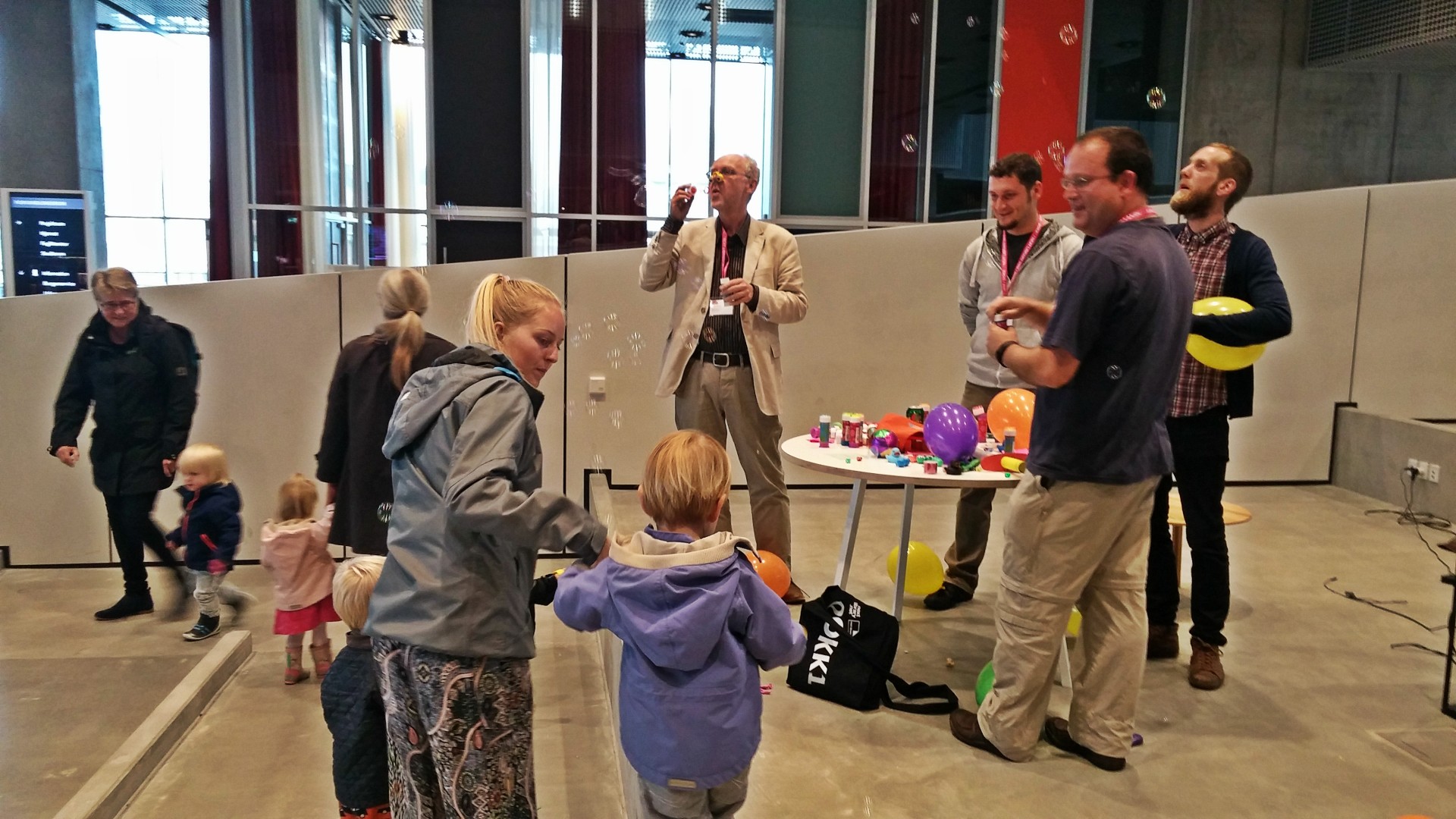
    This session was longer (90 minutes) and took place in the open space at the ramp in the middle of DOKK1.

    After my brief introduction, we played a couple of rounds of the wonderful “Turtle Wushu” developed by Invisible Playground (I wasn’t able to find turtles, alive or plastic, so maybe what we played was in fact “Dice Wushu”).

    TurtleWushu_3 (Medium)

    We only played for 10-15 minutes, but it really had an impact on the energy of the remainder of the session.

    I then talked for a bit, trying to provide som background for the game we just played and the upcoming play jam. My basic argument for playing and being silly is something like this:

    It’s not so much about the games or play activities as such, but rather about learning to be playful.

    Together, we came up with three words or dogmas and each group would choose one of these as a starting point for developing a “new form of play” in 30 minutes:

    When the groups started jamming, an already nice atmosphere turned into something almost magical. They were so engaged in the task at hand and clearly didn’t hold themselves back.

    In the end, we had three concepts that could readily be played by others, each based on one of the three dogmas.

    Sensing/senses

    In the beginning, this was played with a blindfold or eyes closed. You had to sense where the other players were and then smash their balloon.

    In the final version, you were allowed to see, and you could defend yourself with bubbles that the other players couldn’t move through.

    Discovery

    The idea behind this was the fact that we rarely go exploring the spaces we often visit.

    You begin by spinning a bottle. Then you go in that direction, and introduce yourself to the first stranger you meet and challenge that person to a “bubble race”. You blow a bubble each, and try to move that bubble as far as you can.

    Excitement

    Here, you had to stand in a designated spot and play out one of three roles: blow bubbles, catch bubbles or use a piece of paper to prevent the catching of bubbles.

    There is a rotation system, so you move between the three roles. That can be done after a set number of bubbles is caught or a set amount of time. You can add more players for increased difficulty (and confusion and laughs).

    All three forms of play were hilarious and certainly made a lot of people (Next participants as well as regular library visitors) smile and laugh.

    The fact that the workshop took place out in the open created a disturbance and “friction” for the regular guests at the library, which was extremely interesting to watch:

    This was one of the best experiences I’ve had doing a workshop for a long time and only because of the wonderful, sincere and hugely energetic effort of the participants!

    One of the participants said to me, with a big smile, that he hadn’t done something like this since he was a child – with the underlying question: WHY haven’t I done something like this since I was a child? (well, that was my interpretation, at least).

    That really meant a lot to me.

    Other people came up afterwards and thanked me, which made me a little proud and super grateful, but it also just made me want to thank the participants. They did most of the work and they made sure the session was that much fun.

    I need to do something like this again soon. It seems to be even more valuable than I would have expected.

    Here’s my presentation:

  • Our stories from play

    Jesper K. Kristiansen

    At CounterPlay ’14, Jesper Krogh Kristiansen did a presentation about the way we write and talk about games.

    Traditionally, there’s been a heavy focus on technology when writing about video games, but this is not really what most people really care about (some people do, and that’s ok).

    Most of us would probably rather talk about all the things we experience when playing games, or how games allow us to explore the most amazing worlds, or the ways in which we connect with games and other people on an emotional level, or how games make us consider the world and our lives in new ways.

    Why don’t we just go and do this, then?

    A big part of this is probably the perceived lesser cultural value of games compared to, say, literature, film and theater. Even today, we often find ourselves in situations, where we need to overcome mental and cultural barriers to properly talk about games without feeling a bit out of place.

    Another reason might be our lack of knowledge and language about games. Basic knowledge about stories, about literature, about film is everywhere around us, and we are introduced to theories in these domains at an early age. This is not the case with games (yet).

    These things are obviously changing, as more people play games, and more people care to tell what they experience, think and feel.

    Take Tom Bissell’s account of “doing cocaine and playing video games – usually Grand Theft Auto IV“:

    What have games given me? Experiences. Not surrogate experiences, but actual experiences, many of which are as important to me as any real memories. Once I wanted games to show me things I could not see in any other medium. Then I wanted games to tell me a story in a way no other medium can. Then I wanted games to redeem something absent in myself. Then I wanted a game experience that pointed not toward but at something. Playing GTA IV on coke for weeks and then months at a time, I learned that maybe all a game can do is point at the person who is playing it, and maybe this has to be enough.

    Or Manveer Heir‘s touching & inspiring microtalk at GDC 2013(see the transscript):

    And by the end of Papo & Yo, I was sobbing profusely, unable to contain my emotions. I was a grown man breaking down in his living room. I’ve never experienced that gravity of emotion from media. You’d have thought I’d just found out someone close to me had died. And that’s because it sort of happened. Papo & Yo didn’t make me cry because of the arc of narrative, or because it timed emotional music right. It made me cry because it asked me to do something seemingly simple: let go. And then it made me let go. Not the character in the game, it made me, Manveer, let go.

    It made me remember my relationship with my estranged younger brother, the anger and hatred I had towards him for years, and remember his subsequent suicide in late 2011. It made me remember the difficulty I had consoling my parents as the only surviving child. It made me remember how sorry I felt for him because he suffered from bipolar disorder, a mental disease that often made him do and say things that ended our relationship. It reminded me how unwilling myself and society was to let him off the hook despite knowing this. Papo & Yo reminded me of something I already knew but have struggled with: the need to let go of anger, the need to forgive and look towards the future, the need to grow as a person and become better every single day, lest I be destroyed by a monster inside of me.

    Or Cara Ellison’s thoughtful piece about how “Castles In The Sky” evoked feelings of childhood, good and bad:

    If this were a platformer, perhaps this would be boring. But this isn’t really a platformer, so much as a bedtime story. This is more like taking a journey back into your childhood, where when you looked up at the sky, you thought clouds might be able to sustain your weight, if you wanted. When clouds were reachable platforms for all your idle thoughts.

    […]

    There’s a rush of old feelings for me in that moment where those words clash with a hot air balloon rising proudly from behind the cloud cover. My heart swells. I don’t recall primary school; I’m not quite sure what happened but I have blocked out the memory of that time. But the game’s idea that all lost balloons might find new owners is an allegory that hauled up the hopes that I think my ten year old self had once. I think perhaps ten year old me wanted to think that all lost balloons are found by someone, just like all little boys grow up, except one.

    Stories like these are interesting and fascinating in their own right, while also helping us understand better how games can mean much more to us than simply entertainment (mind you, there’s nothing wrong with entertainment).

    During his talk, Jesper asked the audience to share their own experiences from playing, and here are all the stories that we collected (download here):

    I’m pretty sure, that this topic is going to be a central part of our ongoing conversations around games and play!

    Do you have a story to tell?

    Share it in the comments!