Category: Society & Politics

  • Play Against Instrumentalization

    Play Against Instrumentalization

    [et_pb_section fb_built=”1″ _builder_version=”3.19.2″][et_pb_row _builder_version=”3.19.2″][et_pb_column type=”4_4″ _builder_version=”3.19.2″ parallax=”off” parallax_method=”on”][et_pb_text _builder_version=”3.19.2″]

    I have written before about the horrors of the “ROI society” in which we live, and in a more recent post, I argued that “play resists “instrumentalization”, reminding us that some actions are undertaken with no rewards or external purpose in mind. Play is the primary purpose of play.

    This calls for some unpacking, as I believe it will prove to be an essential part of the argument I’m slowly trying to make.

    If we have no aspiration outside economic achievements, is there even room or reason for democracy to exist? It can’t all be quid pro quo and return on investment. Democracy has to do better than that.

    I believe that if democracy is to thrive, to mean something again, we have to learn how to insist on principles, ideas, thoughts and activities with inherent value, regardless of their financial value.

    Danish professor of psychology, Svend Brinkmann, is frequently arguing against the dominating logic of instrumentalization:

    “I will argue that instrumentalization in our time has become so pervasive that it threatens other ways of thinking, which are far more fundamental in regards to living a good and meaningful life. Instrumentalization effortlessly cover that which is actually meaningful” (my translation).

    He even mentions play as an example a phenomenon that exists outside the realm of instrumentalization, an “autotelic activity”, something that “has a purpose in and not apart from itself”.

    I also found this theme in Wendy Brown’s harsh criticism of neoliberalism in “Undoing the Demos”:

    “As economic parameters become the only parameters for all conduct and concern, the limited form of human existence that Aristotle and later Hannah Arendt designated as “mere life” and that Marx called life “confined by necessity” — concern with survival and wealth acquisition — this limited form and imaginary becomes ubiquitous and total across classes. Neoliberal rationality eliminates what these thinkers termed “the good life” (Aristotle) or “the true realm of freedom” (Marx), by which they did not mean luxury, leisure, or indulgence, but rather the cultivation and expression of distinctly human capacities for ethical and political freedom, creativity, unbounded reflection, or invention.”

    She goes on, showing also how the neoliberal logic inevitably leads to the death of democracy:

    “the normative reign of homo oeconomicus in every sphere means that there are no motivations, drives, or aspirations apart from economic ones, that there is nothing to being human apart from “mere life.” Neoliberalism is the rationality through which capitalism finally swallows humanity—not only with its machinery of compulsory commodification and profit-driven expansion, but by its form of valuation. As the spread of this form evacuates the content from liberal democracy and transforms the meaning of democracy tout court, it subdues democratic desires and imperils democratic dreams.”

    I honestly feel chills run down my spine when I read this. It’s pure dystopia, as if taken straight from the most terrifying future scenario even the most skilled sci-fi writer could come up with. Only difference is, it’s real, here and now.

    Judith Butler presents a similar argument in “Notes Toward a Performative Theory of Assembly”:

    “we are in the midst of a biopolitical situation in which diverse populations are increasingly subject to what is called “precaritization.” Usually induced and reproduced by governmental and economic institutions, this process acclimatizes populations over time to insecurity and hopelessness; it is structured into the institutions of temporary labor and decimated social services and the general attrition of the active remnants of social democracy in favor of entrepreneurial modalities supported by fierce ideologies of individual responsibility and the obligation to maximize one’s own market value as the ultimate aim in life.”

    “the obligation to maximize one’s own market value as the ultimate aim in life” – is that really all we can ever hope for?

    It’s quite popular to see play as an instrument to achieve lots and lots of things, from learning and creativity over a wretched from of “resilience” to economic growth and maximizing “one’s own market value”. Now, there can indeed be worthwhile and valuable outcomes of play, but if that’s our primary concern, we misunderstand play altogether.

    We need to look at play through a different prism. Like Miguel Sicart in “Play Matters“, I too see “play as a struggle against efficiency, seriousness, and technical determinism.”.

    Play does not care in the least about all these quantifiable outcomes or results. Instead, play teaches us to stop obsessing over all of that, as it only really thrives when we dare to stop thinking about the returns on our playful investments. When play happens like that, all anyone cares about is that moment, that shared experience of being in play together.

    As such, play might be the antidote we so desperately need. Maybe play can remind us that the otherwise widespread instrumentalization can be resisted? That there is indeed more to life and to democracy than maximizing profits?

    Even in the bleakest moments, I hope so. On the best of days, I actually think it might just be possible, but only through collective action, rooted in (play) communities. 
    [/et_pb_text][/et_pb_column][/et_pb_row][/et_pb_section]

  • The Politics of Play

    The Politics of Play

    [et_pb_section fb_built=”1″ _builder_version=”3.19.2″][et_pb_row _builder_version=”3.19.2″][et_pb_column type=”4_4″ _builder_version=”3.19.2″ parallax=”off” parallax_method=”on”][et_pb_text _builder_version=”3.19.2″]

    Some might say that this whole thing about “play and democracy” is a misunderstanding, forcing play into a space, where it doesn’t belong: the realm of politics.

    Having said before that there’s no forcing play, obviously I want to avoid that. I really, really want to avoid that.

    The thing is, though, that play is already always political. In fact, it could be argued that play is indeed more political than contemporary politics as it is taking place in parliaments and similar institutions.

    How is that?

    Several political theorists have described how we’re now living in an era of “post-politics” or “post-democracy”, as Colin Crouch describes the situation in his “Post-Democracy” from 2004:

    “The fundamental cause of democratic decline in contemporary politics is the major imbalance now developing between the role of corporate interests and those of virtually all other groups. Taken alongside the inevitable entropy of democracy, this is leading to politics once again becoming an affair of closed elites, as it was in pre-democratic times.”

    Chantal Mouffe elaborates:

    “Politics therefore has become a mere issue of managing the established order, a domain reserved for experts, and popular sovereignty has been declared obsolete. One of the fundamental symbolic pillars of the democratic ideal – the power of the people – has been undermined because post-politics eliminates the possibility of an agonistic struggle between different projects of society which is the very condition for the exercise of popular sovereignty”

    The “hegemony of neoliberalism” has effectively eliminated the space for democratic plurality, and without that, there are no politics to be conducted, only technicalities to be “managed” by “experts”.

    In the words of Lynne Segal:

    “Neoliberalism has had one remarkable success, despite all its own contradictions and disasters. Its extraordinary victory has been ideological: it has convinced so many that its version of predatory, corporate capitalism is inescapable; that political resistance is inevitable.”

    This is often expressed as the “politics of necessity”, even by politicians, which seems strange when you think about it, since they thus effectively contribute to the undermining of democracy and the space for doing politics. Politicians against politics, quite the slogan, huh. That’s where we are, however, at an unfortunate and undesirable impasse where the traditional realm of politics leaves little room for the political.

    [/et_pb_text][et_pb_image src=”http://www.counterplay.org/wp-content/uploads/2019/01/LegeEdCamp-4644-9-Large.jpg” _builder_version=”3.19.2″][/et_pb_image][et_pb_text _builder_version=”3.19.2″]

    What about play, then?

    For starters, play won’t ever accept the politics of necessity.

    Reawakening our imagination, lifting our spirits, bringing us hope, play is political precisely because it insist that there are always alternatives, other ways of living, and it encourages us to explore these possible worlds together. Play is, according to a definition by game scholars Katie Salen and Eric Zimmerman in “Rules of Play”, “free movement within a more rigid structure”. While I don’t intend to wade into any lengthy discussion of definitions, I contend that play can’t ever exist without some degree of “free movement”. Absent such freedom, we risk entering into what Huizinga dubbed “false play” in “Homo Ludens”, further unpacked by Thomas S. Henricks as “that perversion of human creativity that occurs when organizations take over and manage play for their own ends”.

    Hence, when Judith Butler argue that:

    “The ethical question, how ought I to live? or even the political question, how ought we to live together? depends upon an organization of life that makes it possible to entertain those questions meaningfully.”

    …I propose that play allows for such an “organization of life”. When we play, we, explicitly or implicitly, ask and examine those questions of how to live and to live together. This takes me back to that quote from Henricks I used in the first post of this series:

    “I argue that play is that social laboratory. When we play with others, we create and administer a publicly acknowledged reality () When people agree on the terms of their engagement with one another and collectively bring those little worlds into being, they effectively create models for living.”

    Furthermore, play resists “instrumentalization”, reminding us that some actions are undertaken with no rewards or external purpose in mind. Play is the primary purpose of play. Play also has a profound social dimension, refusing to embrace the individualism also brought by neoliberalism (see “Recognizing the Other”).

    For these reasons, and many more yet to be examined, I don’t consider it a heretic act to connect play and democracy. Play is political by nature and I believe that if we set it free and follow its path, play might lead us to a radically different way of doing democracy and living together.

    [/et_pb_text][/et_pb_column][/et_pb_row][/et_pb_section]

  • Recognizing the Other

    Recognizing the Other

    [et_pb_section fb_built=”1″ _builder_version=”3.19.2″][et_pb_row _builder_version=”3.19.2″][et_pb_column type=”4_4″ _builder_version=”3.19.2″ parallax=”off” parallax_method=”on”][et_pb_text _builder_version=”3.19.2″]

    I recently asked if play can save democracy, marking the first steps on my journey to explore what I already at the outset consider a deep kinship shared by play and democracy. As promised, there is no clear answer in sight, but some patterns and questions are surfacing.

    One such theme revolves around equality and “recognizing the other”, seeing eye to eye across our differences. Equality is traditionally considered a “pillar of the democratic ideal” (Mouffe, 2018), and “participatory democracy underlines the need to create the conditions for real equality” (della Porta, 2013). What happens, then, when we find ourselves in a situation where the following questions, asked by Judith Butler, are acutely pressing:

    “Which humans count as the human? Which humans are eligible for recognition within the sphere of appearance, and which are not?”

    And she continues:

    “The very fact that I can ask which humans are recognized as human and which are not means that there is a distinct field of the human that remains unrecognizable, according to dominant norms”

    This (widespread!) unwillingness to recognize “the other” is poison to democracy.

    In “Not for Profit: Why Democracy Needs the Humanities”, Martha Nussbaum argues that the humanities can teach us to “imagine sympathetically the predicament of another person” and that this is indeed a fundamental prerequisite for any democracy:

    “When we meet in society, if we have not learned to see both self and other in that way, imagining in one another inner faculties of thought and emotion, democracy is bound to fail, because democracy is built upon respect and concern, and these in turn are built upon the ability to see other people as human beings, not simply as objects.”

    Some would say that this is only possible in homogenous societies, where “respect and concern” are expected to somehow emerge from a shared history and culture. I strongly disagree with this notion, however, and Nussbaum’s argument is, by no means, a call for homogeneity. On the contrary, I believe she assumes that society is already heterogeneous and diverse, but that we can – and must! – learn to embrace and appreciate this diversity.

    We must trust that the other, because without trust, democracy is impossible.

    [/et_pb_text][et_pb_text _builder_version=”3.19.2″]

    The same can indeed be said for play. Without trust, we can’t play together. On the contrary, play thrives when we allow ourself to be present in the moment, to show vulnerability, to be open to whatever might happen. There’s a strong sense of “togetherness” in play, as I wrote a while ago:

    “Play only works if we’re simultaneously aware of the needs of ourself and the other. It’s a dance, back and forth, looking into yourself and reaching out into the world () play becomes a demonstration of empathy, an exploration of being together in ways that respect us all. Play is a lesson in humanity, a gentle reminder of all the things we have in common across age groups, nationalities, religions, socio-cultural backgrounds and other differences that usually keep us apart.”

    Or as my friend Bernie wrote so beautifully in “A Playful Path”:

    “When we are playing together, despite our differences, we celebrate a transcendent sameness, a unity that underlines the illusion of our separateness. You could call this an act of love – an enacted love that lets us keep the game going. Many acts of love, in fact, many acts of compassion, caring, trust, assurance.”

    This resonates with play scholar Stuart Brown, who writes that “taking part in this play is a way to put us in sync with those around us. It is a way to tap into common emotions and thoughts and share them with others” and continues:

    “I would claim that sustained emotional intimacy is impossible without play. This is true not only for married bliss, but for continued vitality in long-term friendships.

    “Without the various forms of social play we would find it very hard to live together. (…) Play is the lubrication that allows human society to work and individuals to be close to each other.”

    He’s far from alone in insisting that play has the capacity to radically transform and deepen our social interactions and relationships. On the contrary, it’s a recurring theme across the field of play studies.

    Can play break down the barriers between people, bringing us closer together, helping us see eye to eye?

    Yes. Yes, I sincerely believe so, and that is one reason why play can lead us to a reinvigorated democracy.

    [/et_pb_text][/et_pb_column][/et_pb_row][/et_pb_section]

  • Can Play Save Democracy?

    Can Play Save Democracy?

    [et_pb_section fb_built=”1″ admin_label=”section” _builder_version=”3.22″][et_pb_row admin_label=”row” _builder_version=”3.25″ background_size=”initial” background_position=”top_left” background_repeat=”repeat”][et_pb_column type=”4_4″ _builder_version=”3.25″ custom_padding=”|||” custom_padding__hover=”|||”][et_pb_text _builder_version=”4.4.1″ hover_enabled=”0″]

    It’s a big question and one that I’m afraid I can’t answer in the affirmative. Not yet, probably never. I’m not sure democracy can ever be saved, at least not in an ultimate sense. It’s in the nature of democracy to be more about process, ongoing negotiations, exchanges, corrections and conflicts – tedious, messy and anxiety-inducing as these may seem.

    Perhaps we should view democracy more like Alan Watts thought of life:

    “We thought of life by analogy with a journey with a pilgrimage which had a serious purpose at the end the thing was to get to that end success or whatever it is or maybe heaven after you’re there. But we missed the point the whole way along it was a musical thing and you were supposed to sing or dance while the music was being played.”


    So what if even the best we can ever do, despite gargantuan efforts, will always fall short of “saving” democracy, if we can only hope to keep it alive, or, better yet, to make it come alive? And what if that is exactly what play brings to the table – life? As my friend, the late Bernie DeKoven kept saying: “playfulness will lead us back to life itself”.

    Isn’t that worth working hard for, worth fighting for?

    I, for one, think so, and that feeling grows stronger by the day.

    While I have long been interested in play, participation, power and similar topics, I have only recently developed a more direct and explicit connection to democracy itself. I must admit that for a long time, I took democracy for granted. We know that relationships between people suffer when they take each other for granted, and any love that was there eventually withers away. The same is true for democracy, and taking it for granted, assuming it would always be there, was a big mistake, if a common one. Growing up as a white, middle class male with a decent (free!) education in a fairly solid (social) democratic welfare state like Denmark, sheer privilege didn’t allow me to see how deep trouble we’re actually in.

    As David Runciman writes in “How Democracy Ends”:

    “Contemporary representative democracy is tired, vindictive, paranoid, self-deceiving, clumsy and frequently ineffectual. Much of the time it is living on past glories”.

    Most democracies, all over the world, are in a state of crisis, and it seems deeper and more severe than many of us had assumed. The outlook is bleak:

    “The question for the twenty-first century is how long we can persist with institutional arrangements we have grown so used to trusting, that we no longer notice when they have ceased to work. () A hollowed-out version of democracy risks lulling us into a false sense of security. We might continue to trust in it and to look to it for rescue, even as we seethe with irritation at its inability to answer the call. Democracy could fail while remaining intact.” – David Runciman

    Even so, at this tense moment, it’s not too late to act (or so I have to believe), but things have to change and radically so. Once upon a time, democracy gave people hope of a better future, of more equal societies, of shared decision making, and while the future looks less bright, there’s hope still:

    “Despite democracy’s many failures, it remains a stirring dream, a fantasy, an ideal that has taken various institutional forms over time and generated hopes for creating equitable social, economic, and political arrangements now and in the future.” – Temma Kaplan

    In the face of neoliberalism’s “politics of necessity”, I am becoming radicalised, insisting instead on the possibility of a different world. Democracy is not supposed to be a dull, bureaucratic process, it’s a matter of life, joy, hope and dreams, and maybe “it is not so hard to turn the struggles for greater participatory democracy into sites of collective exhilaration, given the creativity, strength and agency we can gain from one another along the way” (Lynne Segal)?

    I have begun, slowly and without any clear destination, to chart these waters, exploring the many connections between play and democracy. It is an attempt to weave together different strands of knowledge, finding vantage points from where to survey the land, to gain numerous, diverse perspectives on both play and democracy. This thing I’m making is a patchwork, a messy one that probably won’t be much to look at, but what if we’re wrong to obsess with the aesthetics of democracy? I can’t do “polished”, but that’s a misguided goal anyway. Does it really matter how it looks, if it has the potential to transform society for the better?

    I’m not a proper researcher and this is not a proper research project, rather it is my hope that it will sit somewhere between research and practice, between the theoretical and the empirical. That is, to the best of my knowledge, the space where the most interesting and (sometimes) surprising things happen, when mind and body, ideas and experiences, collide, merge and enrich each other.

    Where do an exploration of play and democracy even begin?

    I will probably be travelling along many avenues at once, and then examine the intersections between these: looking into the empirical experiences of “play as democracy”, designing practical experiments (like CounterPlay), talking about it wit lots of different people/groups, while also reading up on the (massive) field of theory and research.

    I believe that we must be equally ambitious with both phenomena, taking them both very, very seriously on their own terms. Play is not some shallow concept we all understand because we were once (or have since had) children. On the contrary, it’s complex, ambiguous, diverse and always moving just outside the reach of our grasp. It calls for passionate, serious study and it demands hard work. The same is true for democracy. We can’t begin this journey by assuming we know what democracy is because the state we live is called a democracy, and we’d be thoroughly mistaken if we reduce it to winning a majority at election night.

    There has to be more to it, as Donatella della Porta argues in “Can Democracy be Saved?”:

    “The quality of decisions could be expected to decline with the decline in participation, as the habit of delegating tends to make citizens not only more apathetic, but also more cynical and selfish. Participation is instead praised as a school of democracy: capable of constructing good citizens through interaction and empowerment”

    I’m driven by instinct, a gut feeling and an assumption that there is something special about play when it comes to (democratic) participation. On top of that, I have seen with my own eyes what play can do, I have created arenas for this to happen, I have talked to people far more knowledgeable than me and I have read (some of) their works.

    For democracy to thrive, it must be something we *live*, an approach to life and the world, driven by a sense of agency and capacity to act in and change societies through everyday negotiations. Just like play, democracy proper is unruly, encourages participation and diversity, and keeps evolving to adapt to the needs of the people involved:

    “I argue that play is that social laboratory. When we play with others, we create and administer a publicly acknowledged reality () When people agree on the terms of their engagement with one another and collectively bring those little worlds into being, they effectively create models for living.” – Thomas S. Henricks

    What I’m hinting at is not some form of pseudo democracy or simulated democracy. It’s not about role-playing democracy (however important and meaningful that can also be!). I don’t see play as not real; “play is not detached from the world; it lives and thrives in the world” (Miguel Sicart). To me, play is democracy and to play is to act democratically.

    Following the Hero’s journey, this is the call to adventure and I hope you’ll join me. I have no idea where we’ll end up, but we can only make it together (in a very literal sense).

    [/et_pb_text][/et_pb_column][/et_pb_row][/et_pb_section]

  • Struggling in a ROI Society

    Struggling in a ROI Society

    [et_pb_section bb_built=”1″][et_pb_row][et_pb_column type=”4_4″][et_pb_text _builder_version=”3.0.91″ background_layout=”light”]

    I gave a talk at “Spilbar” at the National Film School of Denmark yesterday titled ”‘I’m just playing’; the radical act of expecting nothing in return” (follow link for my presentation), where I made an attempt to connect some of the thoughts and questions I’ve been wrestling with for a while now. As is most often the case, I hadn’t really thought this all the way through, but I really appreciated the opportunity to think out loud in public.

    For the occasion, I had made up the (rather depressing) notion of the “ROI society” to describe our collective obsession with “return on investment”. It’s like our current era is almost defined by the desire to always get something in return and the belief that no action is worth undertaking unless it pays off in some way. I consider this a scourge of contemporary society, a flaw (even if it’s a feature, not a bug) causing great misery.

    Here’s the sad face I put up whenever I think of ROI:

    A performance measure used to evaluate the efficiency of an investment or to compare the efficiency of a number of different investments. ROI measures the amount of return on an investment relative to the investment’s cost. To calculate ROI, the benefit (or return) of an investment is divided by the cost of the investment, and the result is expressed as a percentage or a ratio (Investopedia)

    The ROI mentality is evident everywhere in society: in politics, in private companies, public institutions, in education, in the arts, culture, from Kindergarten to University, from we’re born till we die. While I don’t pretend to know exactly how we got ourselves into this mess, the toxic cocktail of neoliberalism and New Public Management certainly contributed greatly:

    We have been induced by politicians, economists and journalists to accept a vicious ideology of extreme competition and individualism that pits us against each other, encourages us to fear and mistrust each other and weakens the social bonds that make our lives worth living (George Monbiot)

    [/et_pb_text][et_pb_text _builder_version=”3.0.91″ background_layout=”light”]

    When we’re all learning to think and act in a specific way, this eventually trickles down into every aspect of our lives, and play suffers as well. In my work, it’s one of the most frequently formulated dilemmas: is play a legitimate purpose or should we harness its ”magic” for other ends? Can play enhance learning? Creativity? Innovation? Efficiency? Loyalty? Motivation?

    Maybe it can, but should it?

    I’m not saying we should never consider returns, outcomes, rewards (or money for our labor), of course, but I’m merely proposing that we shouldn’t do it all the time. We shouldn’t accept living in a ROI regime and we’d benefit massively from also doing things just for the sake of doing them. The same goes for play. Play can have hugely important side effects, but we risk losing sight of play itself if all we care about are these side effects. If we only see play as meaningful when it has an externally defined ”purpose” or goal, we’ve already misunderstood the very nature of play.

    This far, it is all a bit (too) sad, but hey, there’s hope. There’s always hope. While play is clearly suffering from ROI, play is probably also the best antidote we have. To fight the ROI dragon, we must do the opposite of what it dictates, we must embrace play as a legitimate and legitimately rewarding activity in itself.

    What do we do, then? How do we turn hope into action? We have to believe that play matters. That ”just playing” is not only ok, but the initial, revolutionary act we can all take.

    Probably the biggest roadblock to play for adults is the worry that they will look silly, undignified, or dumb if they allow themselves to truly play. Or they think that it is irresponsible, immature, and childish to give themselves regularly over to play. (Stuart Brown)

    The first step for the resistance, then, is to, quite simply, play. Find ways of playing that appeals to you and jump right in. Experiment, goof around, take yourself less serious, join forces with other people, see how you feel about it and what really gets you in a good, playful mood. Take my friend Lynn, for example. Based around the #oneplaything hashtag on Twitter, she arms herself with chalk, heads out into the world, starts playing and embraces where that takes her (even when it snows):

    [/et_pb_text][et_pb_image _builder_version=”3.0.91″ src=”http://www.counterplay.org/wp-content/uploads/2017/11/CounterPlayLeeds-1701-Medium.jpg” show_in_lightbox=”off” url_new_window=”off” use_overlay=”off” always_center_on_mobile=”on” force_fullwidth=”off” show_bottom_space=”on” /][et_pb_text _builder_version=”3.0.91″ background_layout=”light”]

    Now that you’re volunteering for the cause of the playful resistance and want to do more, you can become a play activist, taking play to the streets, inviting more people to play, cultivating communities of play in the process. Finally, we can insist on the possibility of living playfully, making play a “life practice”, an approach to everything we do – as my friend and perhaps my single biggest source of inspiration, Bernie DeKoven, has been demonstrating for decades:

    “playfulness is an even more liberating way of being than play itself, more, well, freeing. More, in fact, revolutionary.”

    We shouldn’t forget to make the love visible. Play is a manifestation of love, and we shouldn’t hesitate to show it to the world. As someone (Jim Thompson, if I’m not mistaken) wrote during CounterPlay Leeds:

    [/et_pb_text][et_pb_image _builder_version=”3.0.91″ src=”http://www.counterplay.org/wp-content/uploads/2017/11/CounterPlayLeeds-1866-Medium.jpg” show_in_lightbox=”off” url_new_window=”off” use_overlay=”off” always_center_on_mobile=”on” force_fullwidth=”off” show_bottom_space=”on” /][et_pb_text _builder_version=”3.0.91″ background_layout=”light”]

    Tell the stories, stand tall, be proud. Don’t fear the weirdly widespread idea that playing is for kids or that it makes you less worthy of respect. It’s the other way around. If you dare to break the mold, challenge the common perceptions and show a different path through life, you’re a hero in my book.

    When we muster the strength and courage to pursue play in this way, something almost magical happens. In play, we negotiate meaning and purpose, we explore possibilities and other ways of being, and, as Miguel said yesterday, in play we create worlds. We imagine and develop worlds within the world and these worlds are not inconsequential, they are not entirely detached from what we tend to call “the real world”:

    When people agree on the terms of their engagement with one another and collectively bring those little worlds into being, they effectively create models for living (TS Henricks)

    There’s a massive, transformational, even revolutionary potential, in just playing. This immense power can’t be predictably controlled, but I think, nonetheless, that there are some things that will happen more often than others.

    When we are playing together, despite our differences, we celebrate a transcendent sameness, a unity that underlines the illusion of our separateness. You could call this an act of love – an enacted love that lets us keep the game going. Many acts of love, in fact, many acts of compassion, caring, trust, assurance.” (Bernie DeKoven, A Playful Path)

    Play cultivates “togetherness”, as it allows us to create and negotiate special conditions for being together. This is a connection I should have made clearer at Spilbar: the social dimension, the ”togetherness of play”, is not something I want to somehow artificially ”force” play to do, it’s what happens when play thrives and is allowed to develop on its own terms.

    [/et_pb_text][et_pb_text _builder_version=”3.0.91″ background_layout=”light”]

    This all resonates with an analysis made by George Monbiot, when he argues that we should develop a new, big and compelling political narrative around a sense of belonging:

    “But by coming together to revive community life we, the heroes of this story, can break the vicious circle. Through invoking our capacity for togetherness and belonging, we can rediscover the central facts of our humanity: our altruism and mutual aid. By reviving community, built around the places in which we live, and by anchoring ourselves, our politics and parts of our economy in the life of this community, we can restore the best aspects of our nature.”

    This is also the central theme in a book by Lynne Segal I’m currently reading, which bears the absolutely wonderful title ”Radical Happiness: Moments of Collective Joy”:

    As the world becomes an ever lonelier place, it is sustaining relationships, in whatever form they take, which must become ever more important. An act of defiance, even.

    It is very important to be aware that Segal is highly critical towards what has been called the “happiness industry” by William Davies and others:

    Today there is a booming field of management research on positivity at work, all designed to keep employees working longer, with corporations such as Google even installing play equipment in their workplaces. Yet Spicer argues that what he calls ‘the cult of compulsory happiness’ can actually render workplaces more miserable, since the implicit ban on negative sentiment often proves ‘emotionally stunting for employees’, especially in difficult situations, by preventing them from expressing the full range of their emotions.

    Play equipment at Google is what I have previously called “playwashing” and clearly in line with ROI thinking – no doubt Google expect a return on their investment. This is *not* what I’m advocating for.

    Even so, there’s a dilemma here: set play free, play without expecting ”returns on your investment”, but consider how it might change all of society for the better? Yeah, at this point, I felt obliged to state the obvious: there’s a fine line to walk between acknowledging the inherent value of play on its own terms and the instrumentatlisation I’m so deeply concerned about. It would be overly ironic if I end up turning play into an instrument to fight instrumentalisation, right?

    I think I’m onto something here, and that play is an essential component in any good life, but even if I’m wrong, what do we have to lose? A world where more people get to play more and live more playful lives? I can live with that. It gives me the same vibe as this classic:

    [/et_pb_text][et_pb_image _builder_version=”3.0.91″ src=”http://www.counterplay.org/wp-content/uploads/2018/03/hoax.jpg” show_in_lightbox=”off” url_new_window=”off” use_overlay=”off” always_center_on_mobile=”on” force_fullwidth=”off” show_bottom_space=”on” /][et_pb_text _builder_version=”3.0.91″ background_layout=”light”]

    During the Q&A and afterwards, it became evident to me that I should have more clearly said that while I’m interested in all kinds of play, I’m aiming to design spaces and create opportunities for a particular kind of play – let’s, for now, call it positive play or hopeful play. I celebrate the diversity of play and I insist that we embrace as broad a spectrum of play as possible, but as I describe in the “CounterPlay Manifesto”, “we do maintain that some ways of perceiving play are more beneficial and meaningful than others”.

    Anyway, it was all a bit rough around the edges, just like this post, but let me know what you think. Does it make sense? Am I disrespecting play while pretending to defend it?

    [/et_pb_text][/et_pb_column][/et_pb_row][/et_pb_section]

  • Playfully Subverting Tech Fetishism

    Playfully Subverting Tech Fetishism

    [et_pb_section bb_built=”1″][et_pb_row][et_pb_column type=”4_4″][et_pb_text _builder_version=”3.0.90″ background_layout=”light”]

    We’ve gotten so used to being surrounded by technology that we often seem to not even pay attention to its presence.

    This is not (just) a good thing.

    The theme on our Facebook page this week is “playful tech” and while we have stayed mostly on the surface level, it is closely tied to deeper and more profound questions about the role of technology in our lives.

    The week began with one of Simone Giertz’ wonderful, silly videos of her “shitty robots”:

    I’d argue that it’s not just fun and robots, however. When Simone builds her ridiculous robots, she challenges what we usually take for granted about technology. She breaks down the “slickness”, lays bare the inner workings and questions our expectations that technology should look good and work well, fulfilling clearly defined purposes. Perhaps there’s a sort of “Verfremdungseffekt” in play here, an estrangement from what is otherwise common, a friction that invites us to think differently about technology. It’s a bit like these playful, but ultimately useless designs.

    This kind of tinkering and playing might lead to a more substantial investigation of the relationship between technology and the very essence of being human. For many years now, we have been so excited about the evolution of ever more impressive technological advances that it have seemed almost heretic to ask if it’s too much, or if we’re losing touch with what matters most. As Professor Genevieve Bell asks: In our focus on the digital, have we lost our sense of what being human means?

    “I know we can still shape that world, and make it into a place which reflects our humanity, our cultures and our cares. We have done so before, and we can do so again. It requires that we enter a conversation about the role of technology in our society, and about how we want to navigate being human in a digital world. I think we have a moral obligation to do just that, to shape a world in which we might all want to live.”

    Since play is essentially an enduring investigation of what it means to be human, we suggest that play is how we might recalibrate our compass to reestablish our bearings in the world. Play to wake your curiosity, to go exploring, to ask questions, to see the world differently, to connect more deeply with strangers, to dare to be you – play to allow yourself to be human.

    Play is a human superpower and a celebration of our capacity to act; or in the words of Thomas S. Henricks,  “Play makes people aware of their capacities for social agency”. Instead of simply adopting play to create more satisfying ways to interact with technology, we should investigate the more subversive, rebellious side of play. This resonates with a talk given by play scholar Miguel Sicart at the PlayTrack conference, where he argued that we have ceded far too much power to automated algorithms that are rapidly eroding the entire foundation upon which our societies are built:

    If we are ever to rebel against the algorithms, we should bring our most subversively playful selves. When we’re playful, we’re less inclined to accept technology at face value, more eager to ask questions, to take it apart, to insist that things could be different and that we could be more human, not less, during the rise of AI and automation.

    Here’s certainly a topic for further investigation, and we’re currently looking into organising a special CounterPlay Tech event (let us know if you want to be part of this).

    What’s your take? How can we playfully subvert the agenda, fostering human agency and recalibrating

    [/et_pb_text][/et_pb_column][/et_pb_row][/et_pb_section]

  • Are the Robots coming?

    Are the Robots coming?

    [et_pb_section bb_built=”1″][et_pb_row][et_pb_column type=”4_4″][et_pb_text _builder_version=”3.0.89″ background_layout=”light”]

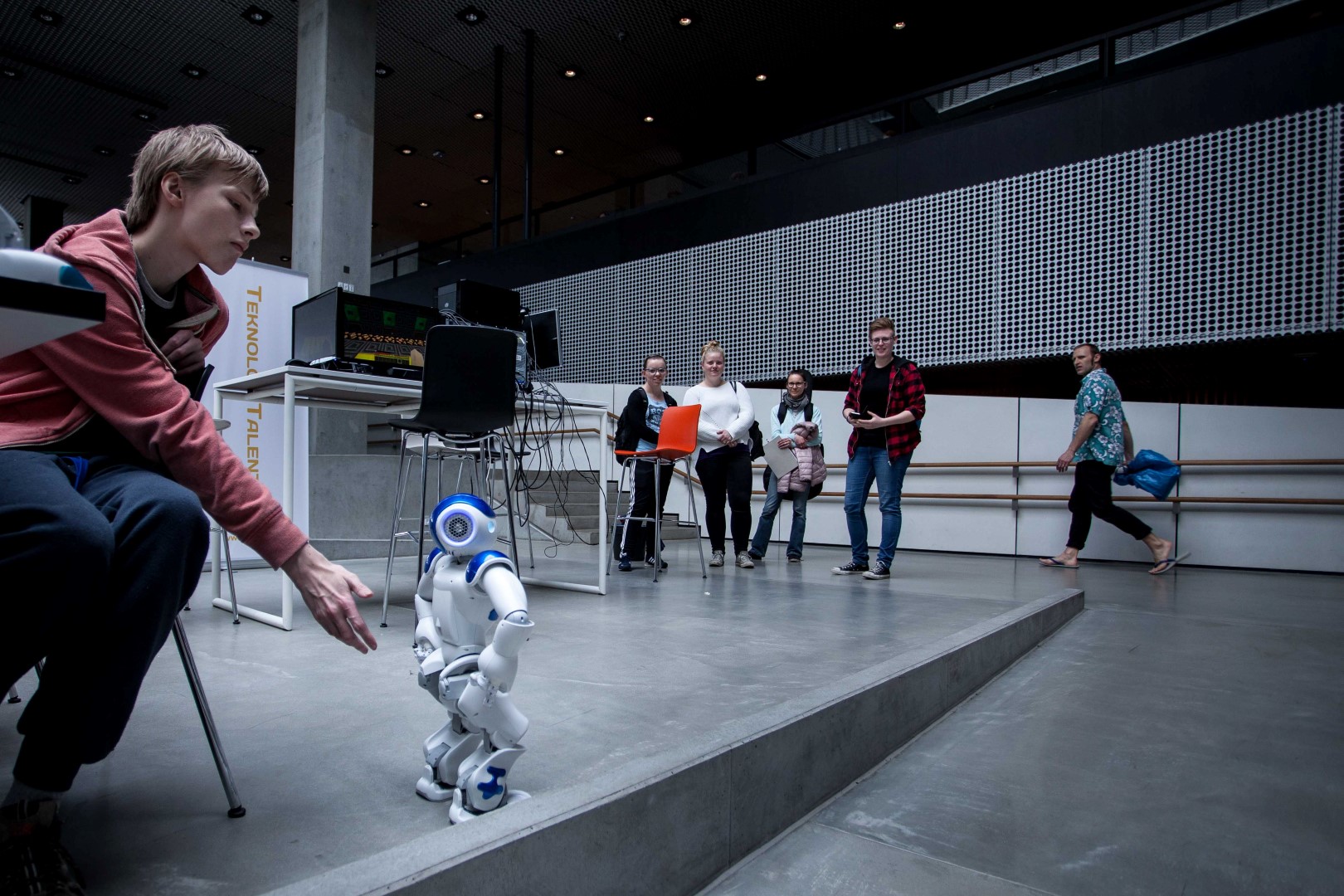
    At debate at this years CounterPlay festival I was confronted by a question I had never thought of asking before. Even though our modern times seem to demand it of us on a daily basis. On our phones, at factories, on labs and libraries, all over the world, the robot is no longer a word reserved for the far off worlds of Science Fiction, the future is now, and the robots? They have come to stay.

    So what do we do – us the human beings? Some of us may already have been replaced, while others might be staring down the barrel at the electronic intern. So let’s take a ride down worst-case scenario; if the robots are here not only to makes things easier, but actually end up taking over our jobs, what are our options?

    In a society that reflects a strong focus on the natural sciences and technology, it can be hard to spot what other possibilities the future beholds, but is play, creativity and the arts not the right place to go for answers? Is art not what sets us apart from each other, from the robot, from the cool, calm and collected science?

    True, this vision is not only dull, but might even seem like an unrealistic dystopia. But I believe the thought is worth exploring, for reflection and sheer curiosity if nothing else.

    [/et_pb_text][et_pb_image _builder_version=”3.0.89″ src=”http://www.counterplay.org/wp-content/uploads/2017/04/DSCF4363.jpg” show_in_lightbox=”off” url_new_window=”off” use_overlay=”off” always_center_on_mobile=”on” force_fullwidth=”off” show_bottom_space=”on” /][et_pb_text _builder_version=”3.0.89″ background_layout=”light”]

    To downplay the arts, to devote your-self to the endless roll of work schedules, payday and calculated free time, is that not the road to stress? Play however has become a term only applied to the past-time of children, and that is where we at CounterPlay propose to start. The language of play is not as well founded as the language of learning. Often play is set into and perceived through the context of learning. It has to occupy a profitable purpose, teach the children something, a tendency that quite frankly complicates the argument of play.

    But why should we even have to argue to play? Play is meant to set us free, free of everyday life, of the norms of civilized society, of the roles of parents, co-workers, mother, brother, sister, teacher and child. That all may sound well and good to you, but how do you do it?

    There is no doubt that to introduce play as play, and play for play’s sake in our modern society is a hard task to undertake, but nonetheless this cause is much too important for us and, I will argue, for YOU! We need to start emphasizing the arts, not dismiss them as unnecessary, silly and a waste of time. We need to recognize the way in which creativity expands our mind, thoughts, feelings and worldview, and thus expand and create our future.

    I can only end my thoughts on one end, to encourage you to challenge your ways, break the rules and expand your mind.

    [/et_pb_text][/et_pb_column][/et_pb_row][/et_pb_section]

  • The Playful Society Prototype

    The Playful Society Prototype

    [et_pb_section admin_label=”section”][et_pb_row admin_label=”row”][et_pb_column type=”4_4″][et_pb_text admin_label=”Text” background_layout=”light” text_orientation=”left” use_border_color=”off” border_color=”#ffffff” border_style=”solid”]

    Maybe you have heard us talk about the CounterPlay festival as a “prototype” of the playful society. I’d like to dive a little deeper into that idea, since it’s basically the most important reason for the festival to exist. It’s our BIG dream to contribute to a strong movement towards the playful society. There’s not an endpoint to this, of course – when is a society truly playful (enough)? It’s more of a guiding principle, a compass for our continued efforts. It reminds us that it’s never just about the festival (even now, when it steals most of our attention). There’s always something bigger, more substantial at stake here: society in it’s entirety. The point is that the festival should mirror the values and principles of play, not just in the content presented, but in the experiences, the atmosphere, the way you feel when you’re there. It should, essentially, be a prototype of the playful society, albeit on a much smaller scale.

    What, then, characterises a playful society?

    Participation

    It’s a core tenet of play that in order to play, you participate, and participation “requires actual power and decision making to be put in the hands of those you expect to play along” (Play as Participation). This takes many forms, including the ongoing negotiation between players: what are we playing? What are the rules? The roles? The purpose? In a playful society, we are all participants, and we all have real power to shape the conditions for our shared lives together.

    [/et_pb_text][et_pb_image admin_label=”Image” src=”http://www.counterplay.org/wp-content/uploads/2016/08/DSCF1727-Large.jpg” show_in_lightbox=”off” url_new_window=”off” use_overlay=”off” animation=”left” sticky=”off” align=”left” force_fullwidth=”off” always_center_on_mobile=”on” use_border_color=”off” border_color=”#ffffff” border_style=”solid”] [/et_pb_image][et_pb_text admin_label=”openness, empathy” background_layout=”light” text_orientation=”left” use_border_color=”off” border_color=”#ffffff” border_style=”solid”]

    Openness

    When we play, we’re present and open to the world and each other in a very unique way. We put ourself into play, so to speak, and we accept that our thoughts, ideas and assumptions challenged. We agree to step out of our “comfort zones”, to explore the unknown, and to embrace unpredictability.

    Empathy

    “When we play with other people – friends, family, colleagues or strangers – we share the responsibility, and we need to be present in the moment, right here, right now. You are open to the world, aware, listening, anticipating, embracing what the other person brings. This is rarely more visible than in the eyes of people playing with each other. The way they shine, the pure joy, this is as close to magic as it gets. In this sense, play becomes a demonstration of empathy, an exploration of being together in ways that respect us all. Play is a lesson in humanity, a gentle reminder of all the things we have in common across age groups, nationalities, religions, socio-cultural backgrounds and other differences that usually keep us apart.” (The togetherness of play)

    [/et_pb_text][et_pb_image admin_label=”Image” src=”http://www.counterplay.org/wp-content/uploads/2016/09/IMG_2386-Medium.jpg” show_in_lightbox=”off” url_new_window=”off” use_overlay=”off” animation=”left” sticky=”off” align=”left” force_fullwidth=”off” always_center_on_mobile=”on” use_border_color=”off” border_color=”#ffffff” border_style=”solid”] [/et_pb_image][et_pb_text admin_label=”Text” background_layout=”light” text_orientation=”left” use_border_color=”off” border_color=”#ffffff” border_style=”solid”]

    Imagination

    Play opens up your mind and your imagination. You see the world in a different light, interpret things differently, and you refuse to simply adhere to common logic and assumptions. You’re not fully disconnected from the “real” world, but you bend and shape the world of play so it feels right. Anything can be anything, and even the most trivial objects or procedures can be endlessly thrilling. Playful people maintain the connection with their imagination, can always find another way, and thus refuse the widespread “politics of necessity”.

    Joy

    When we’re in that particular playful state of mind, engaging in playful play, we feel a deeply satisfying and pleasurable sense of joy. Play is joyful and we shouldn’t be afraid to fully embrace this feeling. Don’t misunderstand it as hedonism and don’t be afraid of what other people might think, it’s a vital component of the good life. You might argue that the joy of play is not real since it’s fleeting and not necessarily sustained for long outside play. You can and you should choose to savour these moments, but you can also make them a regular occurrence throughout your life by living playfully.

    Hope

    With so many terrible things happening, what we need more than anything is hope. Where are we, if we lose hope that the world could be different, that it could be better and more just? In play, there is always hope. With our spirits high, our imagination all fired up, and a strong sense of trust in the play community, we instill in each other the courage to hope. If your approach to life is playful, there is always hope, because you instinctly know that the situation could be different.

    [/et_pb_text][et_pb_image admin_label=”Image” src=”http://www.counterplay.org/wp-content/uploads/2016/09/IMG_1192-Medium.jpg” show_in_lightbox=”off” url_new_window=”off” use_overlay=”off” animation=”left” sticky=”off” align=”left” force_fullwidth=”off” always_center_on_mobile=”on” use_border_color=”off” border_color=”#ffffff” border_style=”solid”] [/et_pb_image][et_pb_text admin_label=”Text” background_layout=”light” text_orientation=”left” use_border_color=”off” border_color=”#ffffff” border_style=”solid”]

    There’s much more to play than this, obviously, but these are important traits, which we aim to build into the festival. Our goal is that everyone feel that participation is real, that they allow themself to be more open and that others do the same, that we extend our empathy, sets our imagination free, and feels a deep sense of both joy and hope.

    What’s worth noticing here is not that this happens at the festival, no, it’s that it can happen anywhere. We don’t have any unique skills, we don’t have access to massive resources or an established platform. If we can create a space where this atmosphere thrives then it should be possible to do the same all over society. Any institution, organisation, company or public space can cultivate a playful culture, where people can actively play a role in strengthening our hope and opportunities for the future.

    [/et_pb_text][/et_pb_column][/et_pb_row][/et_pb_section]

  • Playing with Power

    Playing with Power

    [et_pb_section admin_label=”section”][et_pb_row admin_label=”row”][et_pb_column type=”4_4″][et_pb_text admin_label=”Text” background_layout=”light” text_orientation=”left” use_border_color=”off” border_color=”#ffffff” border_style=”solid”]

    [toc]I am writing this post in response to the call issued by Mathias in his blog post, to “collect and share bits and pieces that demonstrate the power of play to play with power.” I agree that we live at an interesting moment, when it is worth considering whether and what kind of potential lies in games to inspire a challenging of power, and a critique of power structures. I have been involved with a number of projects that have specifically set out to play with power, or to critique power in playful ways, and this post is an opportunity to connect together the dots of those projects. I’ll start with a little bit of relevant theory and then move on to some examples from games and from my own research.

    Turning a lens on how power is enacted

    Ian Bogost makes an argument in his book, “Persuasive Games: the expressive power of videogames,” that the unique experiential characteristic of game playing, the one that is not available with other media, is the requirement of the player to carry out procedures. For example, in a truck driving game, such as Euro Truck Simulator, you’re not simply told about a truck driver, you act as a truck driver making decisions under the constraints that a truck driver typically operates under. You take orders for deliveries, collect trailers full of food and other goods, and drive those goods to far away parts of Europe, following a GPS system, obeying traffic laws and earning money for on-time delivery. Interestingly, sometimes, when you are running low on funds, you find that you need to break the speed limit in order to make the delivery in time.

    According to Bogost, a game can make a powerful argument by requiring your participation in a task, upon which you can later reflect. Instead of being told that truck drivers operate in circumstances that encourage dangerous driving, we experience that pressure ourselves, and understand the importance and power of economic concerns in the day to day decisions of truck drivers. Playing a game makes us act out the argument that it is trying to communicate. It makes us complicit in that argument. In this way, games can make arguments that are very subtle. They can help us understand why people make decisions that initially may seem to be lazy, or dangerous, or against their own interest. The player is placed in a difficult situation, where in order to manage their resources in a strategic manner, they are forced to make decisions of which they would otherwise disprove.

    There are some very good examples of games that make these types of procedural arguments. Papers, Please places the player in the role of a border official, who must check the documents of immigrants:

    As the game progresses, government rules over documentation change regularly and the border official must approve more and more documents per day in order to support the needs of their family. We understand better after playing the game, how these officials make errors, but also why they are often open to bribery. In effect, this game makes an argument about power – instead of blaming the corrupt and stupid border officials, we learn to blame the difficult circumstances that they have been placed under. In the game 3rd World Farmer we are forced to make decisions such as whether to accept toxic waste to be dumped on our land in order to pay for medicine for a sick child. We realise that, given the pressures faced and the resources we have, that there is essentially no solution, or winning condition to this game.

    This section shows how games can make very subtle arguments about the way in which power is enacted. It can turn our attention away from blaming individual human errors, and onto understanding and criticising systemic pressures that those people experience in their lives.

    [/et_pb_text][et_pb_text admin_label=”Blowtooth” background_layout=”light” text_orientation=”left” use_border_color=”off” border_color=”#ffffff” border_style=”solid”]

    Blowtooth – playing with airport security

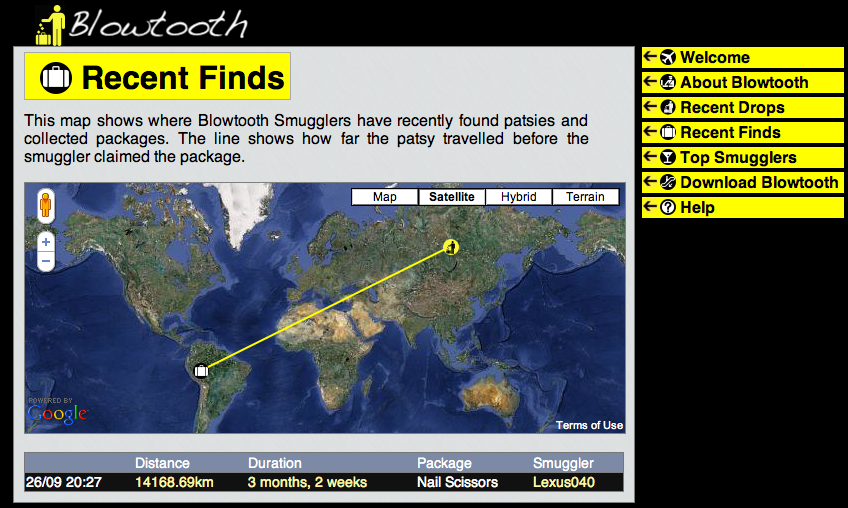
    Blowtooth is a game developed by Ben Kirman in collaboration with myself and Shaun Lawson, when we all worked together at the University of Lincoln. It is a location-based game that asks players to smuggle virtual drugs through real airport security. The intention of the game, unlike those discussed above, is not to engender empathy in the player for real drug smugglers, but rather to direct attention on the security apparatus of the international airport.

    As we write in the paper:

    Blowtooth is specifically designed to exploit the affordances of international airports: environments in which people are subject to particularly high levels of intrusive surveillance and security monitoring.

    Airports have been described as constituting the most authoritarian facility designed for the use of free civilians, an authoritative structure rivalled only by army bases and maximum security prisons. Kellerman describes the movement of passengers through the various security checks imposed by airport authorities in great detail [8] and discusses the impact of these checks on the experience of the international traveller. Throughout this analysis he draws attention to the ubiquitous presence and power of authority figures and the effect of causing tension and anxiety amongst travellers, staff and officials alike (see also [18]). Indeed, airports are places in which oppressive control technologies are implemented and people’s expectations of privacy are altered. Authorities have extra powers to search and detain individuals and there are different expectations on travellers’ behaviour than would be expected outside of this context.

    Thus, through asking the player to act as a drug smuggler, Blowtooth invites the player to more closely examine the security and power structures of the airport – something that most travelers have come to take for granted. Indeed, a quick study demonstrated that Blowtooth provoked participants to think more critically about both the nature of airports, and the idea of playing games in high security environments,

    If you wish to read more about this project, the paper is available for free here.

    [/et_pb_text][et_pb_text admin_label=”Text” background_layout=”light” text_orientation=”left” disabled=”off” use_border_color=”off” border_color=”#ffffff” border_style=”solid”]

    Fearsquare – critiquing the “transparency” agenda

    FearSquare is a website / hack / game developed by Andy Garbett, along with Ben, Shaun and myself, and was later the source of much interesting discussion with Jamie Wardman, and expert in risk communication. FearSquare was developed in response to the decision by the UK government to release crime statistics monthly, at a street-by-street level of detail, as both an interactive map and an easy-to-use API. The release of this map was advertised as a move towards improving transparency in public services. However, as academics, we were very concerned about the social and psychological effects of generating an easily searchable map of all crimes in the UK. For example, what does this information do to those people who find themselves in a “red” zone? What about their house prices and their public services? What about the decisions of people making journeys – will they avoid red zones? Essentially, we were worried that this crime map would become a force that would encourage ghettoisation. It has the potential to further inequality. Thus, we created a playful response in the form of FearSquare.

    FearSquare is an application which allows FourSquare users in the UK to easily see the official crime statistics for the places where you ‘check-in’. The intention is to give you a uniquely individual look at the levels and types of crimes you are exposed to in your daily life. Fearsquare provides users with personally contextualized risk information drawn from UK government ‘open data’ crime maps cross-referenced with check-ins from the location-based social network Foursquare.

    Apart from providing crime statistics information for the places that you visit, FearSquare uses some simple game mechanics in an attempt to invert the rhetoric of the UK Crime Map. Players are given a score based on the “danger” level of their check-ins. Leaderboards are created, which reward players with more consistently “dangerous” check-ins. The intention here was to subvert the argument of the map (i.e., that some places are dangerous and should be avoided) by offering rewards for visiting those places, and through doing so undermining the power of those statistics.

    Fearsquare was successful in engaging users for a variety of reasons, including, humour and novelty as well as provoking reflection on important societal issues regarding ethical, social and psychological questions underlying interaction with technology and open government data. Our observations of tweets of this, more critically engaged, nature demonstrated that some users were prompted to think and reflect more deeply and concertedly about the wider issues resulting from use of Fearsquare, digital crime maps and CMC-R (Computer Mediated Communication of Risk).

    Leaderboards were also created for the most dangerous check-in locations. Hilariously, a police station was consistently the most dangerous place in the UK, due to a quirk in how some crimes are reported.

    If you wish to read more about this project, the paper is available for free here.

    [/et_pb_text][et_pb_text admin_label=”Text” background_layout=”light” text_orientation=”left” use_border_color=”off” border_color=”#ffffff” border_style=”solid”]

    Epilogue

    This post is probably long enough at the moment, but before finishing I will just point to another few projects that involved some form of playing with power, which readers may find interesting.

    The paper “Games Against Health” critiques the many recent examples of “games for health” – suggesting that this trend is an essentially neo-liberal one, where government places personal responsibility for healthy living on the citizen in place of providing health care services.

    The paper “CHI and the future robot enslavement of humankind: a retrospective” uses an intentionally playful tone to speak directly to the HCI research community about their own responsibilities in ensuring human agency in technologies.

    I’ll finish with another quote from Mathias’ blog post: “play is powerful because it invites us to play with power.” I’m very interested to read further examples of people playing with power.

    [/et_pb_text][et_pb_text admin_label=”References” background_layout=”light” text_orientation=”left” use_border_color=”off” border_color=”#ffffff” border_style=”solid”]

    References:

    Bogost, I. (2007). Persuasive games: The expressive power of videogames. MIT Press.

    Linehan, C., Kirman, B., Lawson, S., & Doughty, M. (2010). Blowtooth: pervasive gaming in unique and challenging environments. In CHI’10 Extended Abstracts on Human Factors in Computing Systems (pp. 2695-2704). ACM.

    Garbett, A., Wardman, J., Kirman, B., Linehan, C., & Lawson, S. (2014). Fearsquare: hacking open crime data to critique, jam and subvert the ‘aesthetic of danger’. In Proceedings of Korean HCI conference 2014.

    Linehan, C., Harrer, S., Kirman, B., Lawson, S., & Carter, M. (2015). Games against health: a player-centered design philosophy. In Proceedings of the 33rd Annual ACM Conference Extended Abstracts on Human Factors in Computing Systems (pp. 589-600). ACM.

    Kirman, B., Lineham, C., & Lawson, S. (2012). Exploring mischief and mayhem in social computing or: how we learned to stop worrying and love the trolls. In CHI’12 Extended Abstracts on Human Factors in Computing Systems (pp. 121-130). ACM.

    Kirman, B., Linehan, C., Lawson, S., & O’Hara, D. (2013). CHI and the future robot enslavement of humankind: a retrospective. In CHI’13 Extended Abstracts on Human Factors in Computing Systems (pp. 2199-2208). ACM.

    [/et_pb_text][/et_pb_column][/et_pb_row][/et_pb_section]

  • Playing With Power – an Invitation

    Playing With Power – an Invitation

    [et_pb_section admin_label=”section”][et_pb_row admin_label=”row”][et_pb_column type=”4_4″][et_pb_text admin_label=”Text” background_layout=”light” text_orientation=”left” use_border_color=”off” border_color=”#ffffff” border_style=”solid”]

    [Image text: Alex is a friendly guy, but what if he was not? How could this pose be a demonstration of power?]

    The theme for CounterPlay ’17 is “The Power of Play“, and I urge you to not solely understand it in the “usual” sense. I believe the phrase is commonly used to point towards, well, “the power of play”, the way play is powerful and holds transformative potential in a wide range of situations throughout our lives.

    I obviously agree that play is massively powerful, and I think this is, in part, due to the participatory nature of play, which again means play is powerful because it invites us to play with power:

    This is to say that if there is not a shift of power, if those expected to participate are not powerful (to a never precisely defined extent), “at some point participation simply stops being participation”. Participation, then, should not be used as a glossy term to hide the fact that often, there is no real power for the socalled participants. Exactly the same can be said about play and playfulness. Do you want to cultivate a playful culture in the workplace? Well, it can’t be sugarcoating (like ping-pong tables or other gimmicks), it needs to be embedded in the fabric, and it requires actual power and decision making to be put in the hands of those you expect to play along.

    I reiterated this in my discussion of “playwashing“:

    play is only real if it entails real participation and participation is only real if it entails a redistribution of power among the participants. Consequently, an organization is not playful if there is not a connection between the proclaimed presence of play in the organization and the distribution of power.

    Do the opportunities to play (if they are at all there) come with real agency and influence? Are employees frequently engaging in negotiations of rules and purpose of the work they’re doing? Is there a real sense of ownership and a shared responsibility?


    [/et_pb_text][et_pb_image admin_label=”Image” src=”http://www.counterplay.org/wp-content/uploads/2017/01/IMG_2386-Medium.jpg” show_in_lightbox=”off” url_new_window=”off” use_overlay=”off” animation=”left” sticky=”off” align=”left” force_fullwidth=”off” always_center_on_mobile=”on” use_border_color=”off” border_color=”#ffffff” border_style=”solid” /][et_pb_text admin_label=”Text” background_layout=”light” text_orientation=”left” use_border_color=”off” border_color=”#ffffff” border_style=”solid”]

    This way of framing or understanding play, as inherently participatory, subversive, rebellious even, is rapidly becoming more important as politicians all around the world are increasingly ignoring or downright limiting our opportunities for civic participation and, eventually, our freedom. As Bernie DeKoven has told us time and again, “play is freedom” and games are metaphors that allow us to “imagine freedom“. Clay Mazing shows it. Miguel Sicart writes about it:

    Play is like language— a way of being in the world, of making sense of it. It takes place in a context as a balance between creation and destruction, between adherence to a structure and the pleasures of destruction. Playing is freedom.

    Playfulness frees us from the dictates of purpose through the carnivalesque inheritance of play. Through playful appropriation, we bring freedom to a context.

    Thomas S. Henricks touch upon similar perspectives:

    If play has a central quality, it is that this behavior (as action, interaction, and activity), first of all, celebrates people’s abilities to craft their own responses to circumstances free from interference. That distinctive process of making and interpreting, what I have called ascending meaning, is connected intimately to the project of human freedom.

    I’m convinced that playful people are better equipped to play with power, to challenge power, and to insist on freedom, but I also believe we need to explore this in more breadth and depth. Following our logic of cross-pollination and deploying a kaleidoscopic view on play is what leads me to the “invitation” part of this (already too long) post:

    Let’s collect and share bits and pieces that demonstrate the power of play to play with power.

    I’m thinking we could do a series of blog posts right here, but as always, I’m open to any suggestion that will make us, as a community, more knowledgeable on the power of play. Who knows, maybe it can lead to real, powerful and playful activism?

    Do you want to play along? Will you share your experiences, insights and ideas?

    [/et_pb_text][/et_pb_column][/et_pb_row][/et_pb_section]