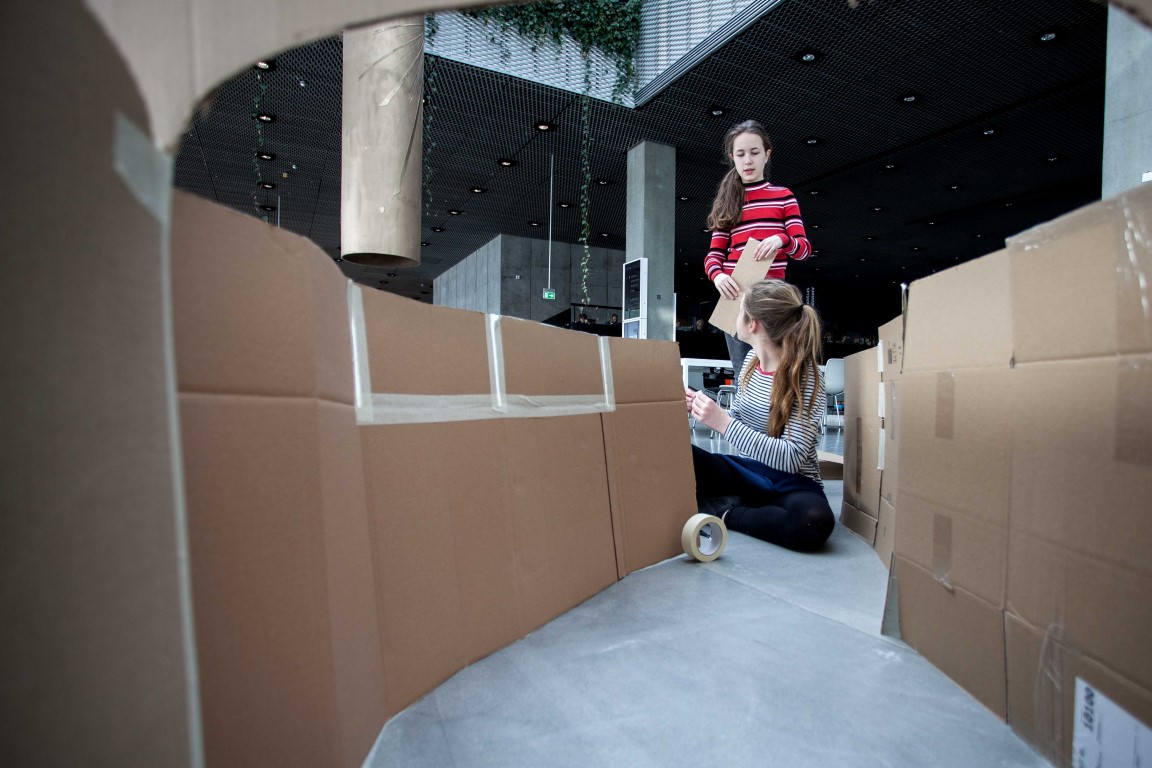
The classic library is a conundrum in and of itself, a building dedicated to the imaginary worlds of fiction, of curious characters from the minds of authors and playwrights, and a space where you are asked not utter a word louder than your breath, and where more angry stares hit your eyes than at a busy train station.
For us CounterPlayers the library is a valued venue, it is a space for us to explore our ideas, and moreover it’s a collaborator and friend that enables our annual festival to become a reality. My job as a volunteer was to make sure that the allocated rooms and spaces where ready for both participants and hosts, and required both a laptop in one arm and a friendly face when walking around asking students, library guests and the like to kindly leave the space open for our festival.
Luckily for me, most students seemed to understand the relevance of a debate staged in the library, others, however, had their doubts as to what a festival of play was doing, first of all in the library, and second of all, why it involved adults.
It was and still is curious to me how the users of such a vast mecca of literature and knowledge are unaware of their own need and desire to play. Are we not, as readers, part of an adventure that far exceeds ordinary life? I would even argue that the pages of non-fiction and newspaper as well as literature require us to step out of our immediate present and let words form the bridge between us and somewhere else. To learn and experience is to take a leap of faith.
Exactly this dilemma was what brought the participants and listeners to the debate in the spring. What are the possibilities of the library, and how do we change the norms adherent to it? Kindergardens, schools and organizations as well as us at CounterPlay, wish for the library to evolve into a room and community that embraces imagination not just in the written word.
Here on our blog I wish to take the question even further: how is it that the library, the home of books, adventures, fairy princesses, epic wars and deceptive murderers is a space of silence? Even the division of a children’s wing indicate a need to separate the immediate imagination and play (and noise?) of children from the seriousness of the adult reader. But I believe that just as much action is present within the mind of the adult reader, and thus the physical space of the library, the seriousness and silence seems to be in clear opposition to the realm of the inner experience.
Perhaps the library should be a place for us to explore and to play, where children are free to move around and experience narrative in their own way? Perhaps a place where old prejudices can be challenged by who knows – a laughing kid, a bubble show, a reading or performance art? Even smaller libraries without the resources for separate rooms for play or immersion might open up the space for a little less quiet and a little more laugh.
We all here at CounterPlay dare you to challenge the conventions of the home of the written word and accept, show and respect the inner need for play and imagination.
The idea about the playground is a wonderful thing.
It shows that we care so much about play that we design spaces to create the best possible conditions for play to thrive.
Playgrounds are, in principle, a love letter to play.
At the same time, many playgrounds are really not that interesting or playful. Even a playground made of the best materials by the best designers can be less than satisfying. You probably know the feeling: is this it?
A big part of the problem is quite often related to the lack of influence given to the player. In an earlier post, I argued that play requires a degree of (real) participation, and that this sort of participation is related to agency, decision making and power.
I think this understanding can be used to explain at least part of the problems with many playgrounds: Everything is decided by someone else, and the people playing can’t really shape the space, hence they are often not really participating, but only doing what the designers or city planners or other people in power desire.
Play scholar Miguel Sicart approaches this from a similar angle, when he, in the book Play Matters, argues that any playspace should be open for “appropriation” or what we might call a “playful takeover”:
The relationship between space and play is marked by the tension between appropriation and resistance: how a space offers itself to be appropriated by play, but how that space resists some forms of play, specifically those not allowed for political, legal, moral, or cultural reasons. Play relates to space through the ways of appropriation and the constant dance between resistance and surrender.
This is a central challenge in any kind of play, and one that clearly highlights again the relationship between play, participation, agency and power.
Who decides how we play?
Sicart continues:
The way spaces are articulated for play is dependent on more than design or playful considerations. Strong norms, rules, and laws govern the use of public and private spaces, and play design must be done in accordance with them. […] In many cases, the trivialization of playground design— the overabundance of plastic-based, repetitive architectures built for safety rather than for play— which seems to have increased in the past several decades, is a result of protective laws rather than of misguided design. And the interest today in implementing digital playgrounds or computer-enhanced environments for play also comes from the normative idea that play is more secure if it is more controlled.
When play is being controlled and regulated, part of it has to do with safety concerns. We don’t want kids (or anyone else playing) to get hurt, so reduce the risk and thus the number of ways to play and to appropriate spaces for play.
In any environment, both the degree of inventiveness and creativity, and the possibility of discovery, are directly proportional to the number and kind of variables in it
The variables are what he defines as “loose parts” and are understood as any element that can be manipulated by participants or players. In other words, loose parts shows a way to open up spaces for participation and appropriation. Conversely, the lack of loose parts, then, reduces these opportunities:
It does not require much imagination to realise that most environments that do not work (i.e. do not work in terms of human interaction and involvement in the sense described) such as schools, playgrounds, hospitals, day-care centres, international airports, art galleries and museums, do not do so because they do not meet the ‘loose parts’ requirement; instead, they are clean, static and impossible to play around with
When hunting for inspiration on how to make playgrounds more playful, the tradition of “adventure / junk playgrounds” is a great place to start:
Adventure play can take a variety of forms, ranging from natural spaces with treehouses and twine forts reminiscent of Huck Finn or Pippi Longstocking, to dump-like playgrounds filled with old tires and plastic junk, to temporary arts and crafts gatherings. (Playworkers, Ph.Ds, and the Growing Adventure Playground Movement)
Adventure playgrounds typically feature a lot of loose parts, hence a lot of opportunities to shape the playground yourself, even in some small way.
Adventure playgrounds help us understand how spaces can be designed for play through the use of props that help play take place within a bounded space while still remaining open to the creative, appropriative capacities of the activity. Good playgrounds open themselves up to play, and their props serve as instruments for playful occupation (Play Matters)
It is very encouraging to see that more and more people are aware of adventure playgrounds and that the movement seems to be building momentum (and I’ll get back to this in an upcoming post).
There are many reasons why most playgrounds are not more like adventure playgrounds, and these reasons reflect the many issues we have with play in a broader perspective. As a society, we are generally too preoccupied with reducing the unpredictable and eliminating risk. This is, however, known to have undesired and sometimes opposite effects:
“When adults take over all responsibility for safety by eliminating danger, numerous problems can arise. One issue is that there is no guarantee that the physical play becomes safer. In many cases, children refrain from engaging in physical play to comply with the adults‟ need for a safer environment. Over time, one consequence can be that, when the children face future physical challenges, they will be ill-informed and inexperienced regarding bodily know-how. Their physical incompetence can actually make their play activity even more dangerous” (Skovbjerg, Elbæk & Rytz)
It’s not just safety concerns driving this, however. There is also the more general tendency of eliminating that which we can’t control and that which will not lead to the desired outcome. The classic definition of play by Huizinga maintains that play is an “activity connected with no material interest, and no profit can be gained by it”. In the current paradigm, where we are so notoriously concerned with measurable outcomes, play is a clearly threat.
We are afraid of play, precisely because play is hard to control, and the same can be said about playgrounds with less regulation, more freedom, loose parts and room for appropriation.
I’m not saying that we should give up making playgrounds altogether, or that all playgrounds should be junk or adventure playgrounds, but simply that there are many complex dynamics in play, and that these can seldomly captured by any one space. The more confined and controlled the space is, the more you reduce the possible spectrum of play. If you tell people how to play, and you create spaces that only accomodate a very narrow definition of “play”, well, you undermine the chances that playful play will happen in that place.
This is also why some of the best spaces to play are not, and will probably never be, designated playgrounds, but spaces “appropriated” for play.
What would make playgrounds more meaningful to you?
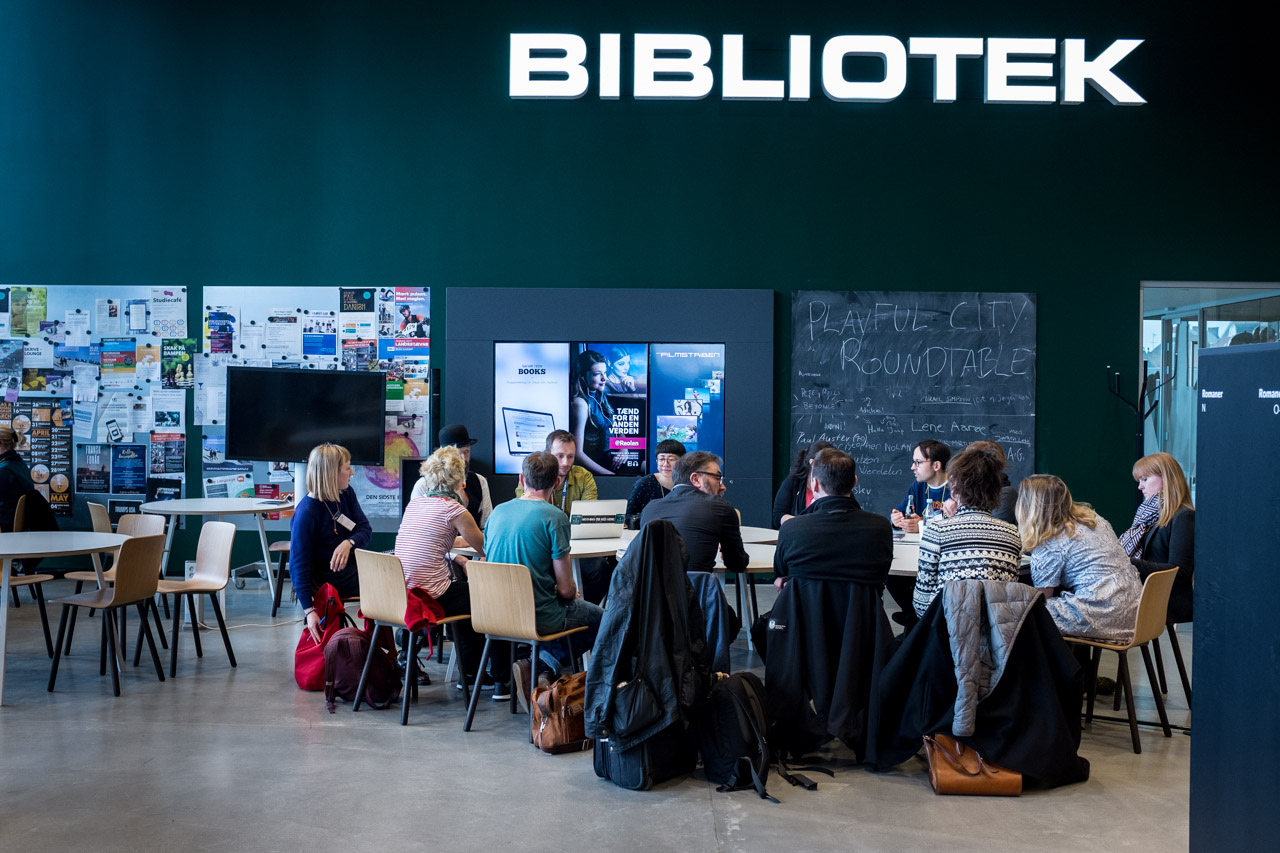
 Luckily for me, most students seemed to understand the relevance of a debate staged in the library, others, however, had their doubts as to what a festival of play was doing, first of all in the library, and second of all, why it involved adults.